
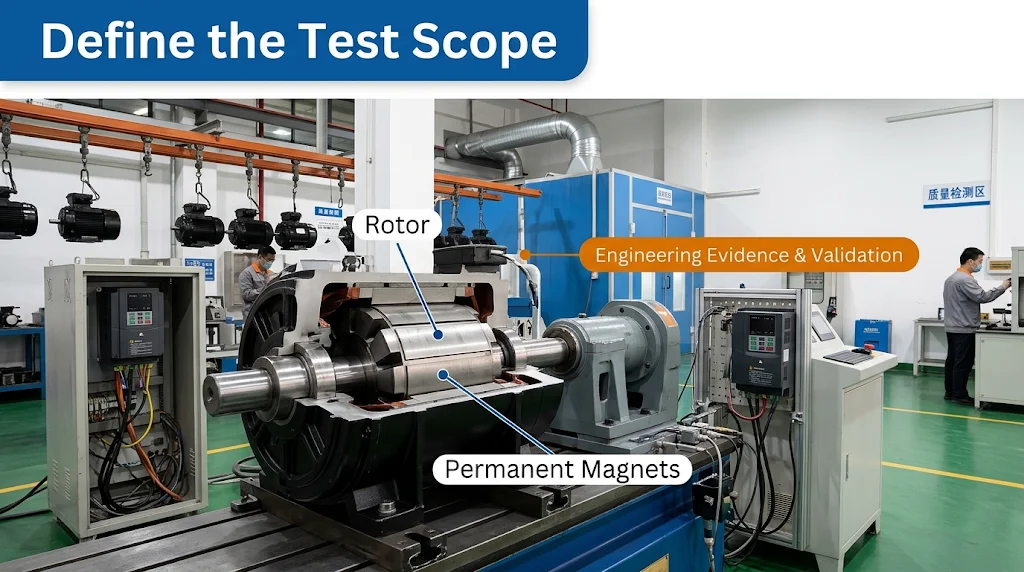
Selecting a Chinese custom PMSM motor manufacturer for an industrial project requires more than identifying a suitable rated power, speed range, or quoted unit price. The proposed motor configuration must meet the actual application requirements, remain within practical manufacturing constraints, and be supported by appropriate engineering and production evidence.
For projects involving custom permanent magnet synchronous motors, the relevant questions concern the complete operating envelope. Continuous and peak torque, base and maximum speed, inverter compatibility, rotor mechanical integrity, cooling, installation conditions, and production repeatability can all influence whether a proposed configuration is suitable.
A manufacturer’s ability to offer customization should therefore be assessed against the specific changes required by the project. Modifying a shaft or mounting arrangement is not equivalent to developing a new electromagnetic configuration, and successful prototype testing does not automatically establish production readiness.
From a manufacturer’s perspective, four connected elements determine whether a custom PMSM order can progress toward a defined production commitment.
The application requirements establish the design basis. Manufacturing constraints determine which configurations can be evaluated. Test and acceptance evidence establish whether the proposed design meets its specified requirements. Commercial terms define exactly what will be manufactured, tested, documented, and delivered.
This article examines how those elements should be connected before a custom industrial PMSM specification, quotation, or production arrangement is finalized.
What Defines a Capable Chinese Custom PMSM Manufacturer?
A capable custom PMSM manufacturer must be able to connect the proposed motor configuration with the engineering, production, and verification requirements of the actual project. A product catalogue may establish the types of motors offered, but it does not independently demonstrate that a particular winding, rotor, housing, or control configuration can be developed and reproduced.
The relevant capability depends on the scope of customization. A mechanical interface modification may require drawing review, dimensional verification, and controlled machining. A new torque-speed requirement may involve electromagnetic design changes, thermal evaluation, rotor engineering, and additional performance testing.
For an industrial custom motor project, capability can be examined through four related areas. These are engineering design resources, manufacturing process control, verification methods, and documented evidence connecting those activities to the proposed configuration.
The objective is not to assume that every manufacturer must own every production operation. It is to establish which organization controls each critical engineering decision, manufacturing process, and acceptance result.
Engineering and Design Resources
Engineering capability becomes particularly important when the requested modification affects the motor’s electromagnetic or thermal operating characteristics.
A proposed PMSM configuration should be developed from a defined application envelope rather than a single nominal performance target. Rated torque, peak torque, operating speed, inverter limits, duty cycle, ambient temperature, and allowable dimensions may impose competing constraints.
For example, increasing continuous torque within an unchanged frame can introduce additional thermal demands. Extending the maximum operating speed may require a different assessment of rotor retention, bearing suitability, vibration, and mechanical stresses. A revised winding configuration can change back-EMF characteristics, current requirements, and compatibility with the intended drive.
These relationships are general engineering considerations, not evidence that a particular manufacturer can achieve a requested design.
For a project involving substantial electromagnetic customization, useful engineering outputs may include a proposed winding configuration, rotor and magnet arrangement, mechanical drawing, calculated operating envelope, and an explanation of the principal design trade-offs.
Where simulations are used, the important evidence is not the name of the software. The relevant question is whether the engineering assumptions are defined and whether the proposed results can subsequently be checked through appropriate measurements.
A design proposal should also distinguish between an established configuration, an optional modification, and a change that requires new engineering validation.
For Hiest-related technical discussions, the application and operating requirements should be used to identify what can be evaluated against existing product references and what requires additional configuration-specific confirmation. No unverified design capability, simulation result, or previous custom project should be assumed.
Production Flexibility and In-House Processes
Production readiness depends on the control of critical manufacturing processes rather than simply on the number of operations performed in-house.
A custom PMSM manufacturing route may involve stator laminations, winding, insulation, rotor magnet assembly, shaft and housing machining, balancing, final assembly, and electrical or mechanical testing. The exact sequence and process ownership depend on the proposed motor design.
When a configuration involves changes to one of these operations, the manufacturing review must identify the affected components, tooling, work instructions, inspections, and production records.
For example, a modified winding may require a different winding process, updated electrical acceptance criteria, or revised insulation verification. A rotor design intended for a demanding speed range may require documented evaluation of the magnet retention method and relevant mechanical acceptance conditions.
In-house production can provide direct process visibility, but outsourced operations are not inherently unsuitable. What matters is whether the responsible manufacturer maintains effective specification control, supplier change management, incoming verification, and traceability.
A manufacturing review should establish which components or operations are produced internally, which are supplied externally, and how design changes are communicated across those interfaces.
Production flexibility also needs to be considered against the expected order profile. A frequently revised low-volume configuration creates different tooling and process-control requirements from an established design intended for repeated production batches.
Neither manufacturing automation nor manual production should be treated as a universal indicator of quality. The appropriate process is the one capable of meeting the agreed specifications and repeatability requirements.
For Hiest, the exact in-house and outsourced process boundaries must be confirmed internally before any specific manufacturing capability is presented as an established company fact.
How to Align Custom PMSM Specifications with Manufacturing Constraints
A custom PMSM specification becomes actionable when electrical performance, mechanical interfaces, operating environment, and manufacturing constraints are considered together.
An RFQ that specifies demanding performance targets without identifying which constraints are fixed can create substantial differences in the proposed design scope. Two configurations may appear to meet the same rated power while differing in thermal capacity, maximum speed, inverter requirements, or installation dimensions.
A more useful technical specification separates mandatory requirements from preferred targets and conditions that can be adjusted during engineering evaluation.
This distinction allows the manufacturer to identify which requirements can potentially be met through an existing configuration and which may involve electromagnetic redesign, special components, tooling, or additional testing.
Critical Performance Parameters and Their Trade-offs
The principal electrical performance variables are interconnected. Rated torque, peak torque, base speed, maximum speed, voltage, current, efficiency, and thermal limits cannot be independently optimized without considering the complete motor-drive system.
For a high-speed PMSM, the maximum operating speed is not by itself evidence that the motor can deliver the required shaft torque throughout the specified range. The continuous torque capability depends on the motor’s thermal and electrical limits, while the available torque at elevated speeds also depends on the inverter and control strategy.
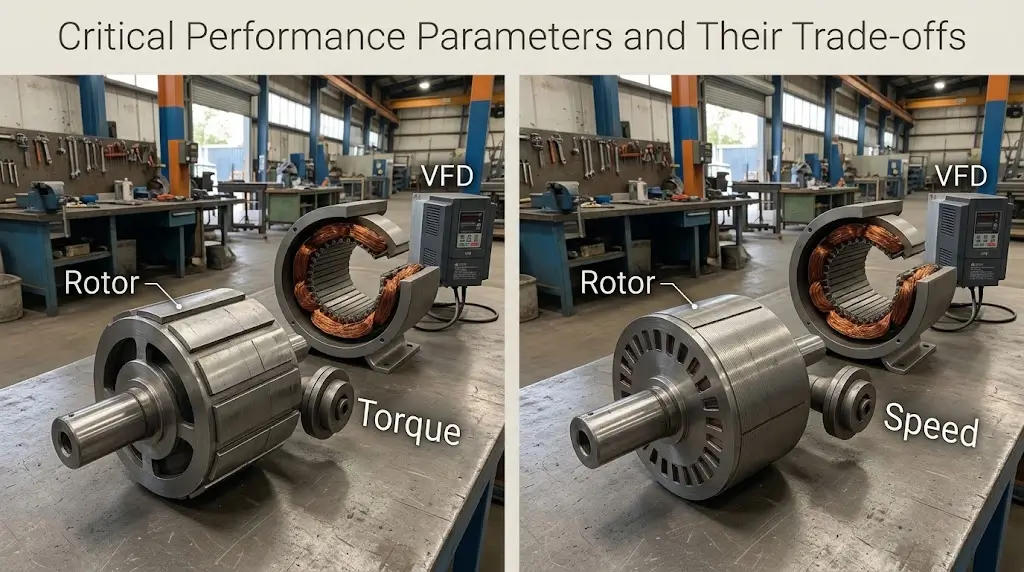
When a project requires operation across a wide speed range, the manufacturer must consider the required back-EMF characteristics, available drive voltage, current limits, field-weakening operation where applicable, and rotor mechanical limits.
A specified speed range should therefore be interpreted as an application-specific operating requirement, not a universal capability of custom PMSM motors or a confirmed Hiest product rating.
Cooling is another major design variable. If the application requires substantial continuous torque within limited installation space, the ability to remove heat may constrain the proposed electromagnetic configuration.
A liquid-cooled design additionally requires the intended coolant conditions to be defined, including inlet temperature, flow rate, pressure limits, interface requirements, and applicable installation restrictions. These values must be verified for the specific configuration.
For inverter-driven PMSM applications, drive compatibility requires explicit evaluation of the control method, voltage and current limits, motor parameter requirements, feedback arrangements, starting strategy, and operating speed range.
An inverter that can operate an induction motor should not automatically be assumed to support every PMSM configuration.
Further technical detail is available in Hiest’s article on PMSM VFD compatibility before motor replacement.
The principal requirements can be organized as follows.
| Technical parameter | Application condition | Engineering consequence | Required confirmation |
|---|---|---|---|
| Rated torque | Continuous mechanical load | Determines continuous electrical and thermal loading | Required torque at defined operating speed and duty |
| Peak torque | Acceleration or temporary overload | Affects current demand and thermal limits | Peak value, duration, repetition, and drive limits |
| Maximum speed | Highest required operating point | Influences rotor mechanical and bearing assessment | Permitted speed envelope and validation method |
| Supply voltage | Available electrical system | Constrains winding and inverter compatibility | Defined supply and DC bus operating conditions |
| Efficiency target | Specified operating points | Influences electromagnetic design and loss evaluation | Measurement method and load points |
| Duty cycle | Continuous, intermittent, or cyclic service | Influences thermal loading | Operating profile and cooling conditions |
| Control strategy | Inverter-driven or line-start arrangement | Changes starting and operating requirements | Intended motor and drive configuration |
Efficiency comparisons require particular care. Motor efficiency, complete power-drive-system efficiency, and actual equipment energy consumption are different measurements.
Where applicable, IEC 60034-2-1:2024 addresses methods for determining motor losses and efficiency, while IEC 60034-2-3:2024 addresses converter-fed AC motor testing. The selected procedure must correspond to the actual motor and test arrangement.
A higher stated nominal efficiency does not independently establish a quantified reduction in the electricity consumption of the installed machine.
Mechanical and Environmental Specification Requirements
Mechanical and environmental constraints must be included before the proposed PMSM configuration is finalized because they can directly affect both the motor structure and manufacturing requirements.
Shaft dimensions, tolerances, mounting interfaces, coupling arrangements, bearing conditions, and permissible installation space determine whether the motor can be integrated into the intended equipment.
A nonstandard shaft or flange may involve additional machining, revised drawings, or configuration-specific dimensional inspection. The required changes depend on the existing design and the equipment interface.
Environmental requirements can introduce further constraints.
Ambient temperature, operating altitude, dust, moisture, corrosion, installation orientation, and cooling conditions may affect material selection, enclosure construction, insulation performance, and the permissible operating envelope.
An IP classification should be confirmed for the proposed motor enclosure rather than inferred from the product family. IEC 60034-5:2020 addresses enclosure protection classification for rotating electrical machines, but it does not independently establish protection suitability for explosive atmospheres.
If the equipment operates in a hazardous area, the relevant explosion-protection requirements must be assessed separately against the actual site classification and target-market rules.
Similarly, a requested water-cooled configuration must be evaluated against its hydraulic and thermal operating requirements rather than being treated as a simple alternative enclosure style.
The mechanical and environmental requirements should be expressed as measurable conditions wherever possible.
These conditions may include shaft diameter and tolerance, mounting-hole geometry, runout requirements, enclosure protection, cooling connections, permitted ambient range, and relevant mechanical test criteria.
Before design approval, the technical review should identify whether each requirement is compatible with the proposed configuration or requires further engineering investigation.
For broader application-based selection considerations, refer to Hiest’s PMSM motor selection guide for industrial applications.
What Evidence Should a Custom PMSM Manufacturer Provide for Capability and Quality?
Engineering and production capability should be supported by evidence relevant to the proposed motor configuration. A quality certificate, product brochure, or generalized performance statement does not independently establish that a specific custom PMSM will meet its required torque-speed envelope or acceptance criteria.
Useful evidence falls into three connected categories. Process documentation establishes how design and manufacturing changes are controlled. Product evidence establishes what has been measured under defined conditions. Compliance documentation establishes whether the applicable market and safety requirements have been addressed.
The necessary documents depend on project risk, motor configuration, applicable requirements, and the stage of technical approval.
For example, a standard mechanical adaptation may require a different evidence package from an extensively redesigned high-speed rotor or a configuration intended for a regulated hazardous environment.
Quality Management System Documentation
Quality management documentation is relevant when it demonstrates how requirements are translated into controlled engineering and production activities.
For a custom PMSM project, the most useful process evidence concerns design revision control, production routing, inspection points, nonconforming product handling, and approval of engineering changes.
These controls become important when a sample is modified after initial testing or when the approved design is transferred into a repeatable manufacturing process.
A revised rotor, magnet specification, winding, or mechanical interface may change the applicable validation scope. The documentation should make it possible to identify which version was approved, which production records correspond to that version, and whether additional testing is required.
An ISO 9001 certification, where held and applicable, provides evidence concerning the certified quality management system and its stated scope. It should not be described as certification of the performance of an individual PMSM model.
Similarly, a manufacturing process chart or control plan is useful only when it is relevant to the proposed configuration and supported by appropriate execution records.
For higher-risk or highly customized requirements, the engineering review may need to identify specific critical characteristics, associated inspection methods, and the evidence required for final acceptance.
The documents required for a Hiest order must reflect the actual available management system, manufacturing arrangement, and agreed project scope. Company certifications and internal procedures should not be represented as verified until the applicable documentation has been checked.
Product Test Reports and Performance Data
A PMSM test report is useful when its measured results can be connected to a defined motor configuration and operating condition.
A general statement that a motor passed inspection provides less information than a report identifying the test object, test method, measured values, conditions, acceptance criteria, and recorded deviations.
For a custom PMSM intended for demanding industrial duty, the evidence may need to cover electrical properties, torque-speed performance, thermal behavior, insulation, mechanical dimensions, and vibration or balancing requirements where applicable.
The relevant operating conditions should accompany the measurements.
For example, a reported efficiency value cannot be meaningfully compared with another result unless the measurement boundaries, operating point, supply arrangement, and testing method are sufficiently aligned.
IEC 60034-1:2026 provides the general rating and performance framework for rotating electrical machines within its scope. For loss and efficiency measurements, the applicable procedure must be selected according to the motor and supply configuration.
For converter-fed motor testing, IEC 60034-2-3:2024 is particularly relevant because converter operation introduces conditions that cannot always be represented by a conventional mains-supplied test.
A complete test review should also consider the identification of the tested motor, equipment calibration status, applicable measurement uncertainty, and whether the report represents a prototype, production-intent sample, or production unit.
These distinctions affect the conclusions that can reasonably be drawn.
An engineering prototype may establish that a proposed design can achieve certain results under specified conditions. It does not independently prove that the same results can be reproduced consistently during production.
Where no configuration-specific testing has been completed, the relevant performance figures should remain proposed design targets or estimates rather than confirmed motor characteristics.
How to Compare Quotes from Chinese Custom PMSM Manufacturers on an Equivalent Basis?
Custom PMSM quotations become comparable only when the technical scope, supplied configuration, validation requirements, and commercial conditions are sufficiently aligned.
A lower quoted unit price does not automatically indicate a lower-cost equivalent motor. It may reflect a different magnetic design, enclosure arrangement, winding configuration, test scope, tooling assumption, or delivery condition.
From a manufacturing perspective, the first requirement is to establish what the proposed price actually includes.
This does not mean that a manufacturer must disclose confidential internal costing or profit margins. It means the commercial offer should clearly identify the product configuration, included deliverables, separately charged activities, and assumptions that may change the final quotation.
Cost Structure and Key Cost Drivers
The cost of a custom PMSM is influenced by its physical design, manufacturing process, validation requirements, and expected production quantity.
Permanent magnets, electrical steel laminations, winding materials, rotor construction, bearings, machining, cooling components, and enclosure requirements may all contribute to the manufacturing cost.
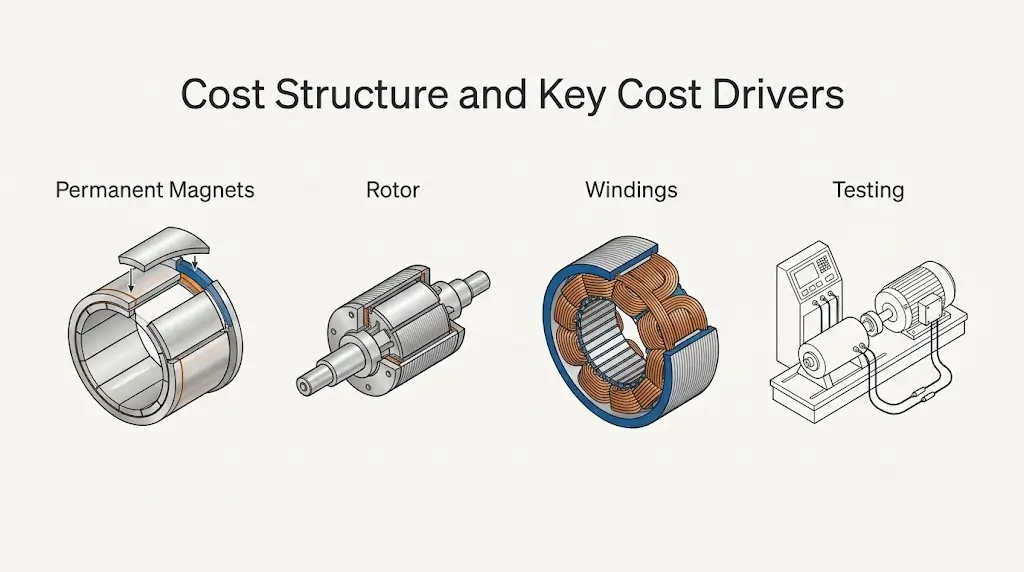
Changes in magnetic material specifications can influence component cost and electromagnetic performance. A revised lamination geometry may introduce additional tooling or processing requirements. Special mechanical interfaces can create additional machining and dimensional inspection work.
The effect of each variable depends on the design. No single cost factor should be assumed to dominate every project.
For commercial comparison, the quotation should distinguish recurring product costs from project-specific activities that may be charged separately.
| Quotation element | Manufacturing or commercial variable | Why it affects the offer | Scope to confirm |
|---|---|---|---|
| Motor configuration | Winding, magnet, rotor, stator, housing | Defines the technical product being supplied | Approved configuration and revision |
| Custom engineering | Design modifications and validation | May require additional development work | Engineering work included or separate |
| Tooling and fixtures | Nonstandard components and production setup | Can introduce nonrecurring expenditure | Ownership, charges, and reuse conditions |
| Testing | Routine and project-specific verification | Affects test work and documentation | Included tests and extra requirements |
| Order quantity | Production volume and setup allocation | Can affect unit economics | Quotation quantity and production assumptions |
| Packaging | Handling and protection requirements | Depends on motor size and transport conditions | Standard or special packaging |
| Delivery | Incoterms and destination | Changes the allocation of costs and responsibilities | Named destination and applicable trade term |
Order quantity can influence how setup and tooling costs are distributed, but this relationship must not be converted into a universal MOQ or price discount assumption.
Material price changes may also affect the validity of a quotation. Any applicable quotation validity period or price-adjustment condition must be explicitly stated rather than inferred.
For a Hiest commercial offer, actual pricing, development charges, tooling policy, sample conditions, MOQ, and delivery arrangements require confirmation against the company’s approved quotation terms.
Additional context on cost drivers can be found in the existing article on Chinese PMSM price strategies and cost analysis.
RFQ Preparation for Comparable Quotes
An actionable custom PMSM RFQ should define the intended engineering result and the commercial scope against which the manufacturer is expected to respond.
For an established OEM project, the relevant RFQ information normally starts with the application operating profile, followed by electrical interfaces, mechanical constraints, environmental conditions, and required validation.
The manufacturer also needs to know whether the buyer expects a standard configuration, a modified existing design, or a substantially new configuration.
These alternatives can have different implications for engineering work, process planning, and validation.
The RFQ should provide enough detail to identify the motor being evaluated without requiring the customer to disclose every proprietary drawing during the initial inquiry.
The minimum useful information may include the equipment type, continuous and peak torque, speed requirements, duty cycle, electrical supply, intended inverter or control method, main mounting constraints, operating environment, target quantity, destination market, and required technical evidence.
For commercial accuracy, the proposed response should distinguish:
- Confirmed standard configuration and included documentation.
- Configurations requiring engineering review.
- Nonrecurring engineering or tooling activities, where applicable.
- Prototype and production validation requirements.
- Commercial conditions that remain subject to confirmation.
The quotation should also identify the currency, quantity, applicable Incoterms rule and named place, validity period, and significant inclusions or exclusions.
If the engineering review identifies a configuration change, that change should be reflected in the relevant drawing or specification revision before the quotation is treated as directly comparable with an earlier proposal.
The practical purpose of this process is not to make every manufacturer quote identical. It is to prevent differences in technical scope from being mistaken for simple differences in selling price.
What Does the Sample Approval and Production Validation Process Look Like?
Sample approval and production validation address two different engineering questions.
Sample approval establishes whether the proposed motor design meets the agreed requirements under defined test conditions. Production validation establishes whether the intended manufacturing process can reproduce the approved configuration consistently.
The distinction matters for customized winding arrangements, rotor designs, high-speed operating requirements, and projects involving new tooling or significant design revisions.
A successful prototype can provide important engineering evidence, but its acceptance should not automatically authorize unrestricted production.
Both stages require agreed acceptance conditions and a documented method for handling deviations.
Sample Testing and Acceptance Criteria
A prototype built for engineering evaluation may not fully represent the tooling, assembly process, or inspection conditions intended for production.
Before sample approval, the parties should identify whether the test object is an engineering prototype, a production-intent unit, or a first article manufactured through the intended production process.
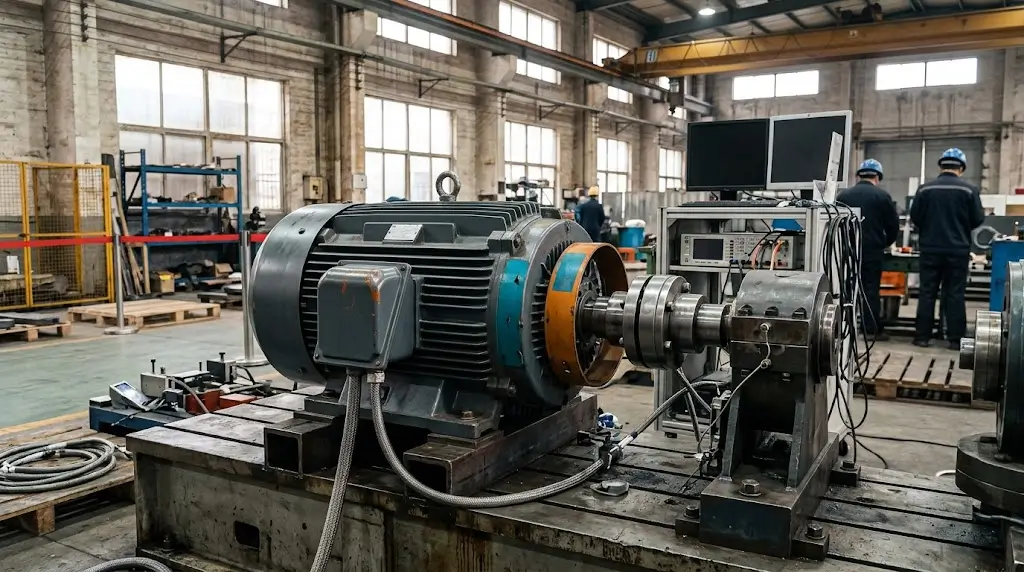
This classification determines what the results can reasonably demonstrate.
The acceptance plan should connect each required characteristic with its test method, operating conditions, acceptance limits, and recorded evidence.
For example, a performance test may need to identify the inverter configuration, supply conditions, load point, ambient temperature, cooling arrangement, and measurement method.
Mechanical acceptance may involve dimensions, shaft and mounting interfaces, runout, vibration, or balancing characteristics where relevant to the project.
A proposed acceptance structure is shown below.
| Verification category | Example characteristics | Conditions to define | Evidence |
|---|---|---|---|
| Electrical | Winding resistance, insulation characteristics, back-EMF | Temperature, measurement method, applicable supply conditions | Recorded electrical test results |
| Mechanical | Shaft and mounting dimensions, runout | Drawing revision, measurement setup, tolerance basis | Dimensional inspection report |
| Performance | Torque, speed, output power, efficiency | Load point, supply, drive, test method | Performance measurement report |
| Thermal | Winding or other specified temperatures | Duty cycle, ambient and cooling conditions | Thermal test record |
| Dynamic behavior | Vibration, balancing, noise where relevant | Speed, mounting and measurement conditions | Applicable inspection or test record |
The exact test requirements must be determined by the project specification and applicable standards. This table does not establish universal pass or fail limits for custom PMSM motors.
Where first article inspection is appropriate, the report should connect specified values with measured results and record the relevant sample identification, measurement details, deviations, and approval status.
Any departure from an agreed critical requirement must be evaluated and resolved through the documented approval process. It should not be treated as accepted merely because the motor operates during a demonstration.
If a design changes after sample approval, the affected requirements and test results should be reviewed to determine whether additional verification is needed.
This preserves the connection between the approved motor design and the configuration that will subsequently be manufactured.
Planning for Production Validation
Production validation should focus on whether the intended manufacturing process can reproduce the approved motor characteristics.
When the project involves an engineering prototype followed by a production-intent build, the evaluation should account for changes in tooling, material sourcing, assembly methods, inspection arrangements, or production conditions.
The first task is to identify the characteristics most important to functional performance and manufacturing consistency.
Depending on the application, these may include winding characteristics, critical mechanical dimensions, rotor-related parameters, insulation requirements, or specified performance measurements.
Production validation should then establish how those characteristics will be inspected, recorded, and assessed against the agreed specifications.
For projects requiring statistical process capability evaluation, the selected characteristics, measurement system, sampling approach, and acceptance rules must be appropriate to the available process data. A generic process capability threshold should not be imposed without considering the project and measurement conditions.
Where a production-intent trial identifies a deviation, the manufacturer must assess whether it arises from a design issue, process variation, material change, inspection difference, or another identified cause.
That distinction determines whether the next action is design modification, process adjustment, additional testing, or a revision to the agreed specification.
Production release should therefore be conditional on the required validation evidence being available and reviewed.
The approved design revision, applicable inspection records, acceptance status, and relevant change-control arrangements should remain connected to the production documentation.
After release, continuing inspection and change management remain important because production conditions and supplied components may change over time.
The required inspection frequency and records should be defined according to the applicable product requirements and commercial agreement.
For Hiest, actual prototype arrangements, first article procedures, production validation records, and testing capabilities must be confirmed before these processes are described as established company services.
How Should Shipping, Documentation, and Compliance Be Handled?
A technically approved custom PMSM configuration is not fully defined for delivery until its shipment conditions, documentation requirements, and applicable market-compliance obligations have also been addressed.
These requirements should correspond to the actual product variant being supplied.
A commercial document that identifies only a generic catalogue model may not adequately describe a customized winding, enclosure, mechanical interface, or other configuration-specific change.
Similarly, compliance evidence associated with a standard motor cannot automatically be assumed to cover every customized version.
Export Documentation and Logistics
The purchase agreement should identify the agreed Incoterms rule, applicable version, named place, and allocation of relevant transport responsibilities.
Incoterms 2020 provides internationally recognized rules for allocating specified delivery obligations, risks, and costs between the contracting parties. The selected rule should be written with the relevant location rather than stated only as a general abbreviation.
The packaging arrangement should also reflect the proposed motor configuration and transport method.
Depending on the motor’s dimensions, mass, construction, and shipment conditions, relevant packaging considerations may include moisture protection, mechanical restraint, cushioning, stacking restrictions, center-of-gravity information, and handling instructions.
These are project-specific packaging considerations, not evidence that a particular method eliminates transport damage.
Before dispatch, the supplied configuration should be reconciled with the applicable commercial invoice, packing list, product identification, and other documents required for the specific transaction.
The necessary export and import documents depend on the countries, product classification, shipment route, and commercial terms.
The manufacturer’s confirmed shipping arrangements should therefore be reflected in the order rather than assumed from a previous transaction.
Product Certifications and Market Access
Product compliance must be evaluated against the intended market, applicable product legislation, motor configuration, and operating environment.
For an EU-bound product, the applicable CE-marking obligations depend on the legislation relevant to the product. A manufacturer may need to prepare an EU declaration of conformity and supporting technical documentation, with third-party conformity assessment required only where the applicable rules specify it.
CE marking should not be described as a universal third-party certificate.
For other destination markets, the applicable safety, electrical, or product-certification requirements may differ. A UL certification or listing, for example, should only be claimed when an applicable record exists and covers the proposed product.
Hazardous-area applications require particular attention.
A motor described as belonging to an explosion-proof product family should not automatically be considered suitable for every potentially explosive atmosphere.
The actual explosion-protection marking, equipment category or protection level where applicable, gas or dust classification, temperature-related limitations, certificate scope, installation conditions, and destination-market requirements must be checked.
IEC 60079-0:2026 addresses general requirements for equipment intended for or associated with explosive atmospheres. The complete compliance assessment may also require other applicable explosion-protection standards and market-specific rules.
A customized enclosure, cable entry, winding, or other relevant modification may require a review of the existing compliance evidence. Whether additional assessment or certification is necessary depends on the nature of the change and the applicable requirements.
For any Hiest custom motor proposal, certification claims should therefore be tied to the exact proposed model or variant and supported by confirmed documentation.
Conclusion
A custom PMSM project becomes ready for a meaningful manufacturing and commercial decision when its application requirements, proposed configuration, engineering evidence, acceptance conditions, and delivery scope are connected.
Rated power and speed alone do not establish suitability. The motor must be evaluated against the actual load profile, drive arrangement, cooling conditions, mechanical interfaces, and intended operating environment.
A manufacturer should also distinguish between an established configuration, a feasible modification supported by existing information, and a requirement that still needs engineering or test verification.
The same distinction applies to quotations and production commitments. A clearly defined commercial scope makes the offer more useful, while configuration-specific test evidence provides the basis for determining whether the proposed motor meets the agreed requirements.
For industrial OEMs and system integrators, the next step is to establish which technical and commercial conditions are already confirmed and which require further review before sample approval or production release.
Request a Custom PMSM Configuration and Validation Review
For a preliminary Hiest technical review, provide the application type, continuous and peak torque requirements, operating speed range, available electrical supply, intended inverter or control method, major installation constraints, and estimated order quantity.
Where available, an existing motor datasheet or nameplate and a basic installation drawing can help clarify the initial requirements.
Hiest can then review the requested configuration against its applicable product information and identify which technical, manufacturing, testing, and quotation conditions require further confirmation. Any final performance, price, certification, or delivery commitment remains subject to the applicable engineering review and approved commercial terms.