
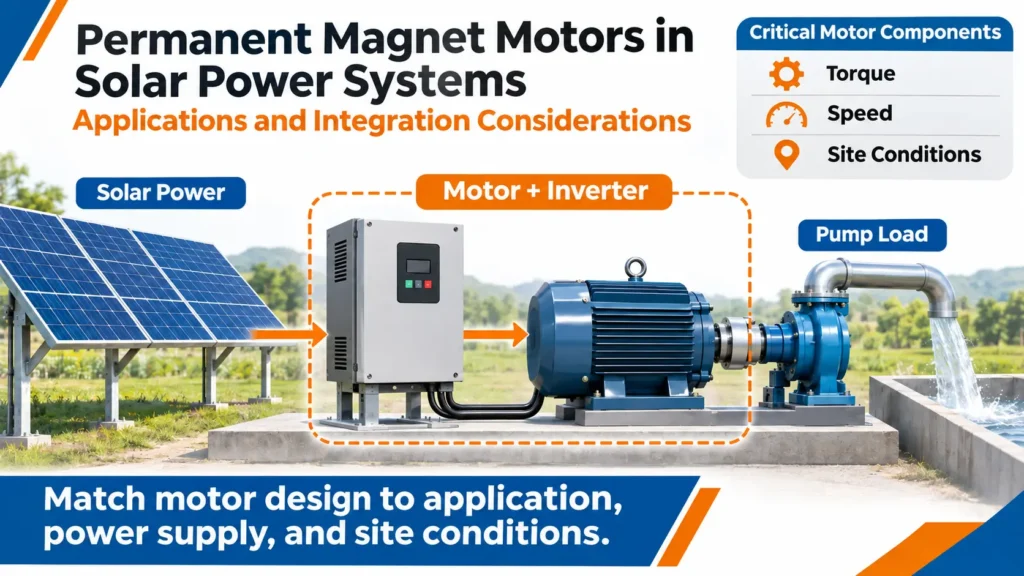
Permanent magnet motors can be used in solar power systems to operate tracking mechanisms, drive solar powered water pumps, and support other motor driven equipment. Their primary function is to convert electrical energy into mechanical motion, rather than generate electricity directly from sunlight.
For solar equipment manufacturers and system integrators, the important question is not simply whether permanent magnet motors are efficient. It is whether a particular motor design can meet the operating demands of the equipment, work with the available power supply, and maintain reliable performance under actual site conditions.
The answer depends on the application. A solar tracking actuator, a photovoltaic powered irrigation pump, and an industrial auxiliary drive have different torque, speed, control, and environmental requirements.
This article explains where permanent magnet motors fit into solar power systems, how their performance affects overall operation, and which integration factors matter when evaluating motor configurations.
What Role Do Permanent Magnet Motors Play in Solar Power Systems?
The first distinction is between producing electricity and using that electricity to perform mechanical work. Solar photovoltaic systems generate electricity through photovoltaic cells, which convert sunlight into direct current electrical energy. Power electronics then condition this energy for storage, local consumption, or grid connection.
Permanent magnet motors perform a separate function. They use electrical power to drive mechanical equipment associated with a solar installation or a solar powered process.
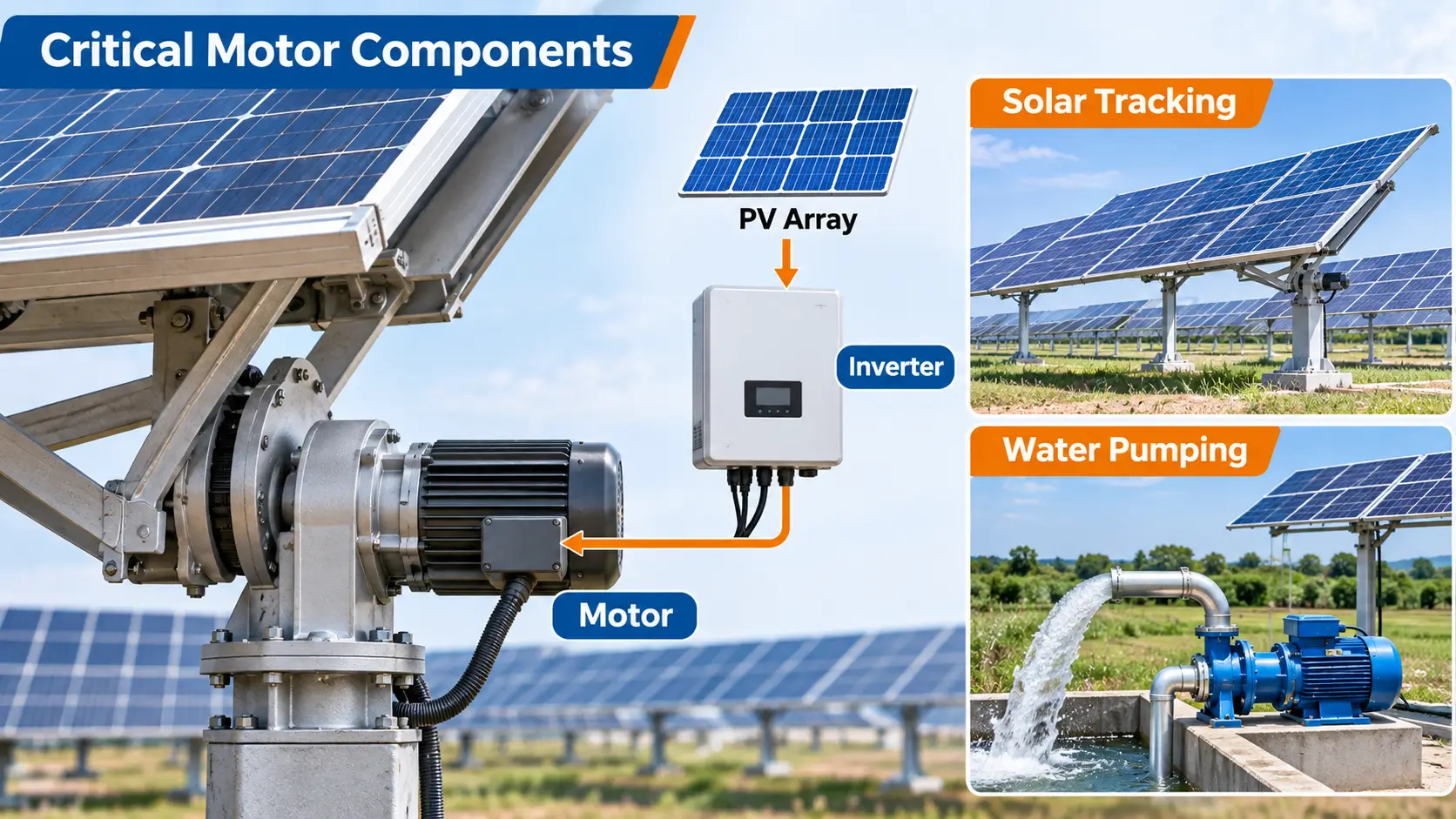
This distinction matters because the efficiency of a motor and the electricity generating efficiency of a solar panel are different performance measures.
For example, a permanent magnet motor may operate a solar tracking mechanism that changes the orientation of photovoltaic modules. In this application, the motor helps position the panels, while the photovoltaic cells remain responsible for converting sunlight into electricity.
In another application, electricity supplied by a photovoltaic array may operate a motor driven water pump. The motor converts available electrical power into shaft power, which the pump uses to move water.
Permanent magnet motors therefore contribute to solar related systems through mechanical drive performance, equipment control, and electrical energy consumption. The actual benefit depends on how each component functions within the complete system.
Main Applications of Permanent Magnet Motors in Solar Power Systems
The operating demands of a permanent magnet motor change considerably with the equipment it drives. Tracking mechanisms require controlled positioning, pumping systems depend on hydraulic performance, and auxiliary equipment must follow its own load profile. These differences determine where a permanent magnet motor can be useful and which configuration deserves closer evaluation.
Solar Tracking Drive Mechanisms
Solar tracking systems adjust the orientation of photovoltaic modules to follow the sun’s position and improve solar exposure during the day.
Electric motors may provide the mechanical movement required by these systems. Depending on tracker architecture, the drive mechanism can include a geared DC motor, brushless permanent magnet motor, linear actuator, or another suitable electromechanical arrangement.
The motor technology is only one part of the tracking system.
Important engineering requirements include the torque needed to move the structure, the speed of adjustment, gearbox characteristics, positioning accuracy, holding requirements, and mechanical response to wind loading.
Tracking motors often operate intermittently rather than continuously. Consequently, rated motor efficiency alone may be less important than reliable starting, adequate peak torque, low standby consumption, and correct actuator integration.
Wind stow requirements are especially significant. A tracking system may need to move panels into a protected position during adverse weather, so the actuator, control system, available power, and structural design must be evaluated together.
A standard industrial permanent magnet synchronous motor should not automatically be considered interchangeable with a purpose designed solar tracking actuator.
Solar Powered Water Pumping Systems
Solar powered pumping is another important application for permanent magnet motor technology.
These systems use electricity generated by photovoltaic panels to operate pumps for irrigation, agricultural water supply, livestock watering, water transfer, and other suitable pumping operations.
A typical AC motor driven solar pumping system combines a photovoltaic array, appropriate power conditioning equipment, an electric motor, and a pump.
Permanent magnet synchronous motors can be considered for applications where motor efficiency and variable speed operation are important to the overall pumping system.
The performance benefit is closely related to the hydraulic operating requirements.
A pumping installation must deliver the required water flow against the actual total dynamic head. The motor must provide sufficient torque and speed for the pump to achieve that operating condition.
Before pairing a PMSM with a solar pumping controller, the electrical and control characteristics must also be considered. The controller needs to support the selected motor type, operate within the available DC input voltage range, and provide appropriate starting and low speed control. Its response to changing solar input is equally important, including whether maximum power point tracking is integrated and how the system manages insufficient sunlight, low input voltage, and automatic restarting. These characteristics affect whether the motor can operate reliably across the expected daily pumping cycle.
When sunlight varies, the available electrical power may also change. A properly designed solar pumping controller can adjust motor operation according to available power while respecting the motor and pump operating limits.
However, reduced motor speed does not always produce useful water flow. For example, a centrifugal pump operating below the speed necessary to overcome the required system head may deliver little or no water.
This means that evaluating a permanent magnet motor for solar pumping requires more than comparing motor nameplate efficiency. The pump curve, motor operating range, controller behavior, photovoltaic power availability, and daily water demand must be considered together.
Motor Driven Auxiliary Equipment
Permanent magnet motors may also be considered for auxiliary mechanical equipment associated with certain solar installations.
Examples include cooling equipment, water circulation systems, cleaning equipment, and other motor driven loads where such systems are actually installed.
In these applications, the motor is not responsible for photovoltaic energy conversion. Instead, it supplies mechanical power to equipment performing a specific operational function.
A variable speed permanent magnet synchronous motor may be relevant where the equipment experiences changing loads and where reducing electrical consumption offers measurable value.
For instance, a motor driven pump or fan with variable operating demand may benefit from a properly matched variable speed drive.
The suitability of a permanent magnet motor must still be assessed against the equipment duty cycle, required torque speed range, mechanical configuration, and control requirements.
Not every solar installation requires these auxiliary systems, and not every auxiliary application justifies replacing an existing motor with a PMSM.
How Can Permanent Magnet Motors Improve Solar System Performance?
Permanent magnet motors can reduce electrical losses in suitable mechanical drive applications, but their contribution to overall solar system performance depends on where and how they operate.
The practical value becomes clearer when motor efficiency, response to changing available power, and the net performance of the complete installation are considered separately.
Motor Efficiency and Electrical Consumption
Permanent magnet synchronous motors use permanent magnets to establish the rotor magnetic field, avoiding the rotor excitation losses associated with conventional induction motor operation.
This characteristic can support high motor efficiency when the motor is appropriately designed and operated.
For solar powered mechanical equipment, lower motor losses may reduce the electrical energy needed to perform the same mechanical task.
However, the actual energy benefit must be evaluated at the relevant operating points.
A motor with a higher rated efficiency does not necessarily consume less energy over the complete duty cycle if the operating speed, mechanical load, inverter losses, or control strategy differs.
Variable Speed Operation and Available Solar Power
In solar powered pumping and similar applications, electrical power availability can vary throughout the day.
A compatible motor drive may regulate the speed and torque of a PMSM according to the available input power and the driven equipment’s operating requirements.
This can help the mechanical system operate within a useful range when solar conditions change.
Nevertheless, the controller must maintain stable motor operation and account for the load characteristics.
The useful result is determined by the complete motor drive equipment combination, not the motor alone.
Net System Performance
In a tracking installation, additional electricity generation depends primarily on the photovoltaic array’s positioning, site conditions, tracker availability, and tracking strategy.
The motor’s electrical consumption is part of the tracking system’s auxiliary energy demand.
A suitable evaluation should therefore distinguish gross photovoltaic energy production from the electricity consumed by tracking and other auxiliary equipment.
For solar pumping, useful performance should be assessed through water delivered under the required head and operating conditions, together with the electrical energy consumed.
This system level distinction prevents motor efficiency improvements from being incorrectly presented as equivalent increases in solar electricity generation.
Motor and Inverter Integration in Solar Powered Applications
One of the most important engineering considerations is how electrical power reaches the permanent magnet motor.
Solar photovoltaic systems and motor control systems can both use inverter technology, but their electrical functions are not identical.
A grid connected photovoltaic inverter converts the DC output of solar panels into AC electricity suitable for connection to an electrical network.
A PMSM motor drive must supply the motor with controlled electrical waveforms and operating conditions appropriate to its electromagnetic design.
These devices cannot automatically replace one another.
PV Powered Motor Drive Systems
In a directly solar powered AC pumping application, a dedicated solar pumping drive may receive DC power from the photovoltaic array and regulate the motor according to available energy.
Depending on the architecture, the controller may combine maximum power point tracking, power conversion, motor control, and protective functions.
For a PMSM, compatibility depends on whether the drive supports the motor type and its control requirements.
Important considerations include allowable DC input voltage, motor output voltage and current, starting behavior, current limits, speed regulation, and protection during low solar power conditions.
A conventional induction motor only solar drive should not be assumed to support a PMSM without verifying its control capabilities.
For a proposed motor and controller combination, the drive manufacturer’s documentation should confirm support for the relevant PMSM control method and electrical ratings. Starting torque, low input power protection, and recovery behavior should be checked against the application requirements and supported by appropriate test evidence where available. Compatibility stated for a general motor family does not necessarily establish reliable operation with a particular motor and pump configuration.
AC Supplied and Hybrid Systems
Some solar installations supply electrical power through an AC distribution system rather than directly from the photovoltaic array.
In such cases, an industrial PMSM may be supplied through a compatible variable frequency drive connected to the AC system. Where an existing drive is being retained, its supported motor control method, voltage and current limits, and commissioning requirements need to be checked against the proposed PMSM rather than assuming compatibility from the drive power rating alone.
Hybrid installations may combine photovoltaic power with utility electricity, battery storage, or another backup source.
The appropriate architecture depends on the required operating continuity, available electrical supply, motor duty, and equipment control strategy.
For projects that need continuous operation despite changing sunlight, the available backup power and switching arrangement may be just as important as motor efficiency.
Key Factors When Selecting a Permanent Magnet Motor for Solar Applications
After identifying the application, the next question is whether the motor can operate within the actual mechanical, electrical, and environmental limits of the project. A suitable power rating is only the starting point, because the required torque, drive behavior, temperature, and installation conditions must work together.
Torque, Speed, and Duty Cycle
The first requirement is to define the actual mechanical load.
For solar tracking systems, the motor or actuator may require intermittent movement, controlled positioning, significant starting torque, and reliable operation during specified wind conditions.
For pumping systems, the relevant operating conditions depend on the pump characteristics, required flow, total dynamic head, operating speed, and duration of operation.
An industrial PMSM must be evaluated against its continuous and peak torque capabilities, permitted speed range, acceleration requirements, and thermal limits. This relationship between the load profile and motor ratings is central to matching PMSM characteristics to different operating conditions, particularly when starting torque and continuous duty place different demands on the motor.
Rated power alone cannot establish whether a motor is suitable.
Power Supply and Drive Compatibility
Electrical compatibility must be checked before selecting a motor configuration.
The evaluation should include the available electrical source, supply voltage, drive output characteristics, motor electrical ratings, and required control functions.
For variable speed PMSMs, the selected drive must support the intended motor control method and operating envelope.
When the system is powered directly by photovoltaic modules, the controller must also accommodate changing input power without exceeding electrical or mechanical limits.
Thermal and Environmental Conditions
Solar related equipment may operate in exposed or demanding environments.
Ambient temperature, dust, moisture, water exposure, solar radiation, and installation conditions can influence motor reliability and service requirements.
For permanent magnet motors, thermal design is particularly important because excessive temperature can affect winding insulation, bearing performance, and permanent magnet characteristics.
The selected motor’s enclosure protection, cooling arrangement, insulation system, and permitted operating conditions must therefore match the installation environment. Where a sustained industrial duty or limited airflow requires a dedicated liquid cooling circuit, Hiest’s water cooled PMSM configurations provide published motor specifications to compare with the required thermal and mechanical conditions. The availability of a cooling circuit and the need for outdoor protection still require separate assessment.
An industrial motor’s published rating should not be interpreted as proof that it can operate outdoors without additional protection or engineering review.
Mechanical Integration and Verification
Motor selection must also consider the connection between the motor shaft and the driven equipment.
Relevant factors may include mounting dimensions, shaft and coupling requirements, gearbox configuration, alignment, permissible mechanical loading, and maintenance access.
The appropriate validation depends on the application. Electrical and mechanical inspections, including the methods described in permanent magnet motor testing, can help establish whether specified motor characteristics have been met. They do not, by themselves, prove that the complete motor, drive, and mechanical system will perform correctly under operating load.
For pumping equipment, tests may need to confirm motor drive operation and the pump’s hydraulic performance across the expected operating range.
For tracking applications, the complete actuation system may need verification of movement, positioning, mechanical loading, protection, and recovery behavior.
A motor that performs correctly during a basic no load test may still be unsuitable for the final installation if the actual mechanical and environmental conditions differ.
Are Permanent Magnet Motors Always the Best Option?
Permanent magnet motors offer useful performance characteristics, but they are not automatically the most suitable or economical drive for every solar application.
The decision depends on the required duty and the complete equipment configuration.
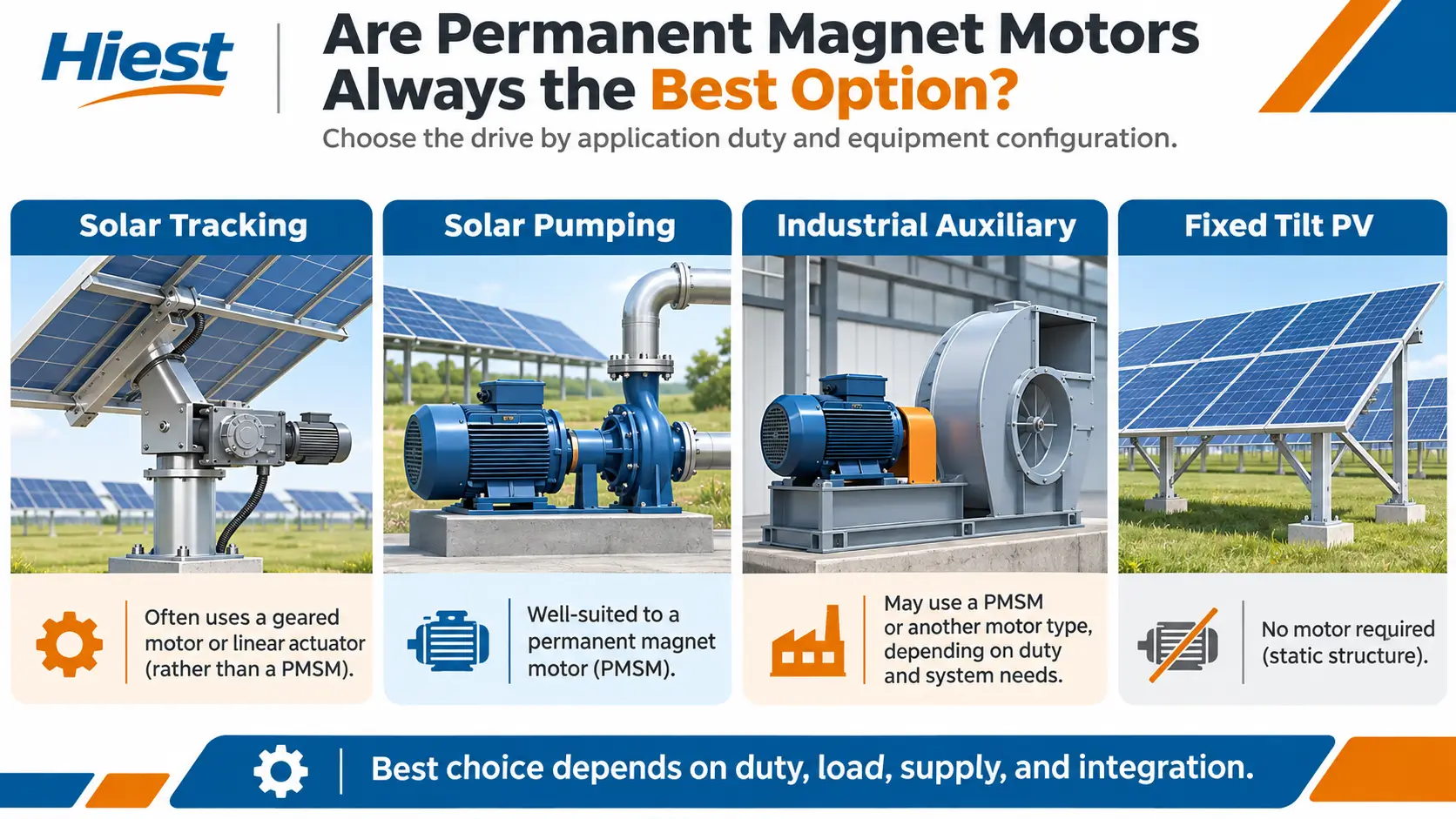
| Application | Relevant drive options | Main decision factors |
|---|---|---|
| Solar tracking | Geared motors, brushless PM motors, linear actuators, or other suitable drives | Positioning, peak torque, wind loading, holding and power consumption |
| Solar powered pumping | PMSMs, induction motors, DC motors or integrated pump motor systems | Pump curve, total dynamic head, operating range and controller compatibility |
| Industrial auxiliary equipment | PMSMs or other appropriate industrial motor types | Load profile, electrical supply, efficiency and integration |
| Fixed tilt PV structures | No tracking motor required | Structural design and fixed installation requirements |
For an intermittent tracking actuator, a purpose designed compact drive may be more appropriate than a larger industrial PMSM.
For an industrial pumping application operating over an extended period, a high efficiency PMSM can be worth evaluating against an alternative motor, particularly when variable speed operation is required.
The comparison should use equivalent mechanical output, operating conditions, and clearly defined system boundaries.
A meaningful assessment considers not only motor purchase price but also drive requirements, mechanical integration, operating energy, maintenance, and expected service conditions.
Evaluating Long Term Reliability and Operating Value
A motor that appears suitable during initial selection still needs to demonstrate reliable operation over the expected service life. Permanent magnet motors do not eliminate the need for maintenance or operational verification.
Although brushless motor configurations can avoid brush related maintenance, bearings, seals, cooling systems, electrical connections, and associated mechanical components remain subject to operating conditions and wear.
For solar related applications, reliability must be evaluated at the system level.
In tracking equipment, a motor failure can affect panel positioning, while gearbox or control failures may produce similar consequences.
In solar powered pumping, an electrical supply problem, motor drive fault, hydraulic restriction, or unsuitable operating point can reduce water delivery.
The performance assessment should therefore distinguish motor related losses and failures from problems elsewhere in the system.
Long term operating value can be evaluated through several measurable factors, including useful mechanical output, electricity consumed, maintenance requirements, equipment availability, and replacement costs.
Without comparable operating data, it is not possible to establish a reliable universal energy saving percentage or payback period for replacing another motor technology with a PMSM.
Evaluating Industrial PMSM Requirements With Hiest
The engineering checks discussed above become the basis for identifying a practical industrial motor configuration. For solar powered industrial equipment, selecting an appropriate permanent magnet synchronous motor requires understanding the complete mechanical and electrical application.
Hiest develops permanent magnet motor solutions for industrial drive applications, including configurations that require evaluation of operating speed, load, cooling, installation, and motor control. For an industrial pump with a defined torque and speed profile, the published three phase rare earth PMSM specifications provide a reference for comparing candidate motor ratings. Those ratings are a starting point for technical assessment, not confirmation of compatibility with a particular photovoltaic pumping controller.
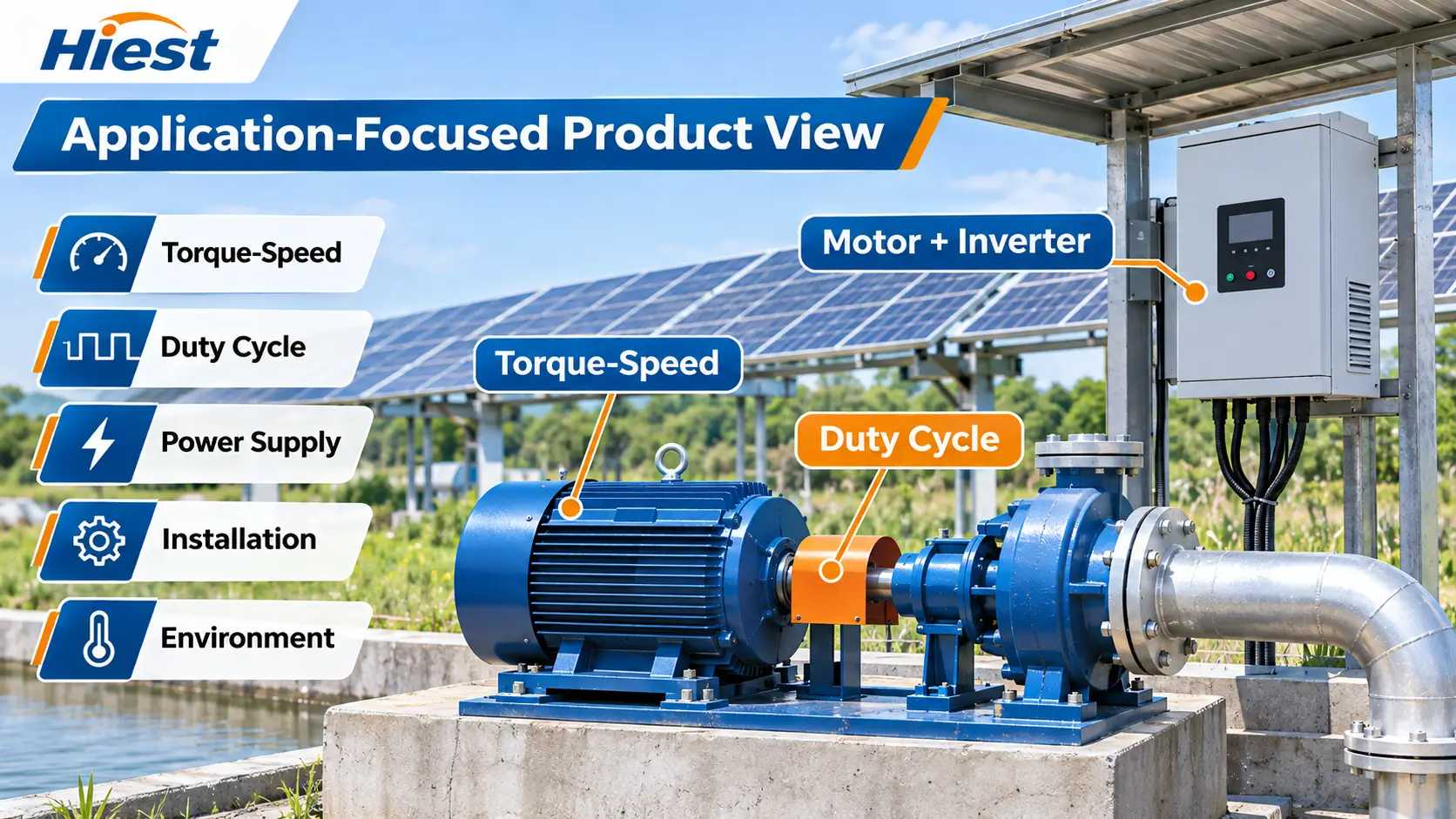
For an industrial pump or other mechanical load powered by a photovoltaic or hybrid electrical system, a useful initial assessment draws on the actual load curve, required output power and torque speed profile, duty cycle, electrical supply, proposed controller specifications, ambient conditions, and mechanical installation requirements. Where the published motor data does not cover the intended operating conditions, compatibility should remain subject to engineering confirmation.
Existing motor specifications, pump curves, and mechanical drawings can help identify whether a suitable PMSM configuration should be evaluated further. The goal is to establish technical compatibility and realistic operating performance before committing to a motor selection.
Conclusion
Permanent magnet motors can serve important mechanical functions in solar related applications, particularly in tracking mechanisms, photovoltaic powered pumping systems, and selected industrial auxiliary equipment.
Their technical contribution depends on the application. In tracking systems, motor driven positioning supports solar collection. In pumping and auxiliary equipment, suitable motor and control technology can improve the performance of electrical to mechanical power conversion.
The most effective approach is to assess the complete system rather than rely on motor efficiency or permanent magnet technology alone.
For industrial applications, torque speed requirements, drive compatibility, power availability, thermal conditions, mechanical integration, and validation remain the principal factors determining whether a PMSM is an appropriate solution.