
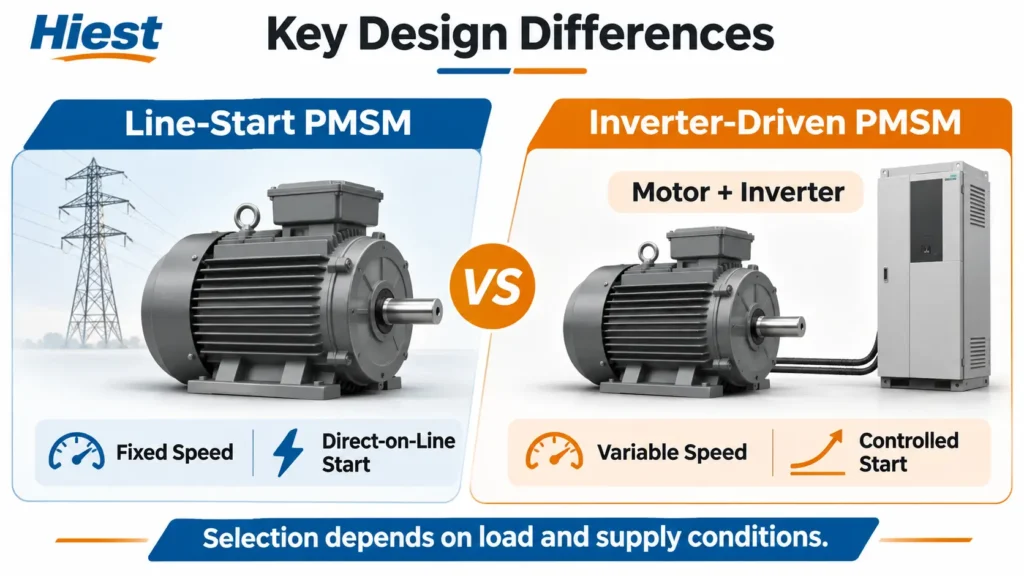
Choosing between a line-start permanent magnet synchronous motor (LSPMSM) and an inverter-driven PMSM is a system configuration decision, not simply a comparison of motor efficiency or rated power.
A line-start PMSM is a candidate when the equipment operates at a fixed speed, the supply can accommodate direct-on-line starting, and the motor can accelerate and synchronize the connected load. An inverter-driven PMSM is generally the better fit when the application requires variable speed, controlled acceleration, restricted starting current, or integration with an electronic control system.
The distinction becomes less straightforward in fixed-speed applications with high inertia, frequent starts, or limited electrical supply capacity. These machines may still require a controlled starting solution even when speed adjustment is unnecessary during normal operation.
For industrial equipment manufacturers and motor replacement projects, the appropriate choice depends on the complete load and operating envelope. Starting torque, synchronization capability, motor-drive compatibility, electrical infrastructure, and lifecycle cost must be considered together.
The comparison below focuses on the conditions that change the final configuration decision, the evidence required to confirm suitability, and the information needed before a motor specification or quotation is finalized.
Line-Start vs Inverter-Driven PMSM: Which Configuration Fits the Operating Requirement?
The first distinction is whether the application needs the motor to start and operate directly from fixed-frequency mains or requires an inverter to control starting and running behavior.
A line-start PMSM uses a rotor designed to develop asynchronous starting torque and subsequently pull into synchronous operation. Its normal direct-on-line operating speed follows the supply frequency and motor pole count.
A typical inverter-driven PMSM instead relies on a compatible electronic drive to establish the required stator excitation. The drive manages acceleration and speed through its control strategy, subject to the motor’s torque, current, thermal, and mechanical limits.
These configurations should be compared according to the functions the machine actually needs.
| Project requirement | Line-start PMSM | Inverter-driven PMSM |
|---|---|---|
| Continuous fixed-speed operation | Candidate if startup and synchronization are feasible | Technically possible but may introduce unnecessary control hardware |
| Variable-speed operation | Not available through ordinary fixed-frequency direct supply | Suitable when the required operating range is supported |
| Direct-on-line starting | Designed for this purpose, subject to motor and load limits | Typical inverter-designed PMSM requires electronic control |
| High-inertia acceleration | Requires specific starting and pull-in verification | Requires drive torque, overload, and acceleration verification |
| Restricted starting current | May be limited by direct-start characteristics | Provides controlled-start options within drive limits |
| Frequent starting | Subject to starting thermal limits and synchronization conditions | Can offer greater control, subject to motor and drive duty limits |
| Existing fixed-speed installation | Potential fit after electrical and mechanical assessment | Requires assessment of drive installation and integration |
| Existing PMSM-compatible drive system | Direct-line advantage may be less relevant | Often a logical configuration to evaluate |
The decision is not an unconditional ranking.
A line-start configuration can be practical where removing the need for a separate inverter is valuable. However, eliminating the inverter does not automatically reduce total project cost if the electrical installation requires modification or the motor cannot reliably synchronize the connected load.
Similarly, an inverter-driven PMSM should not be selected merely because it offers adjustable speed. The additional control capability must solve an actual operating, electrical, or integration requirement.
Decision rule: Establish the required operating speed and starting behavior first. If continuous speed variation is essential, evaluate an inverter-driven PMSM. If the duty is fixed-speed, retain both possibilities until starting, supply, and integration constraints have been verified.
How Line-Start PMSM Starting Capability Affects Application Suitability
For a line-start PMSM, the critical engineering question is not whether the motor can develop torque at standstill. It is whether it can accelerate the actual machine and successfully enter synchronous operation under the specified supply and loading conditions.
A typical LSPMSM combines a rotor starting cage with permanent magnets. The cage develops induction torque during acceleration, while the permanent magnets contribute to synchronous operation after the motor has pulled into step.
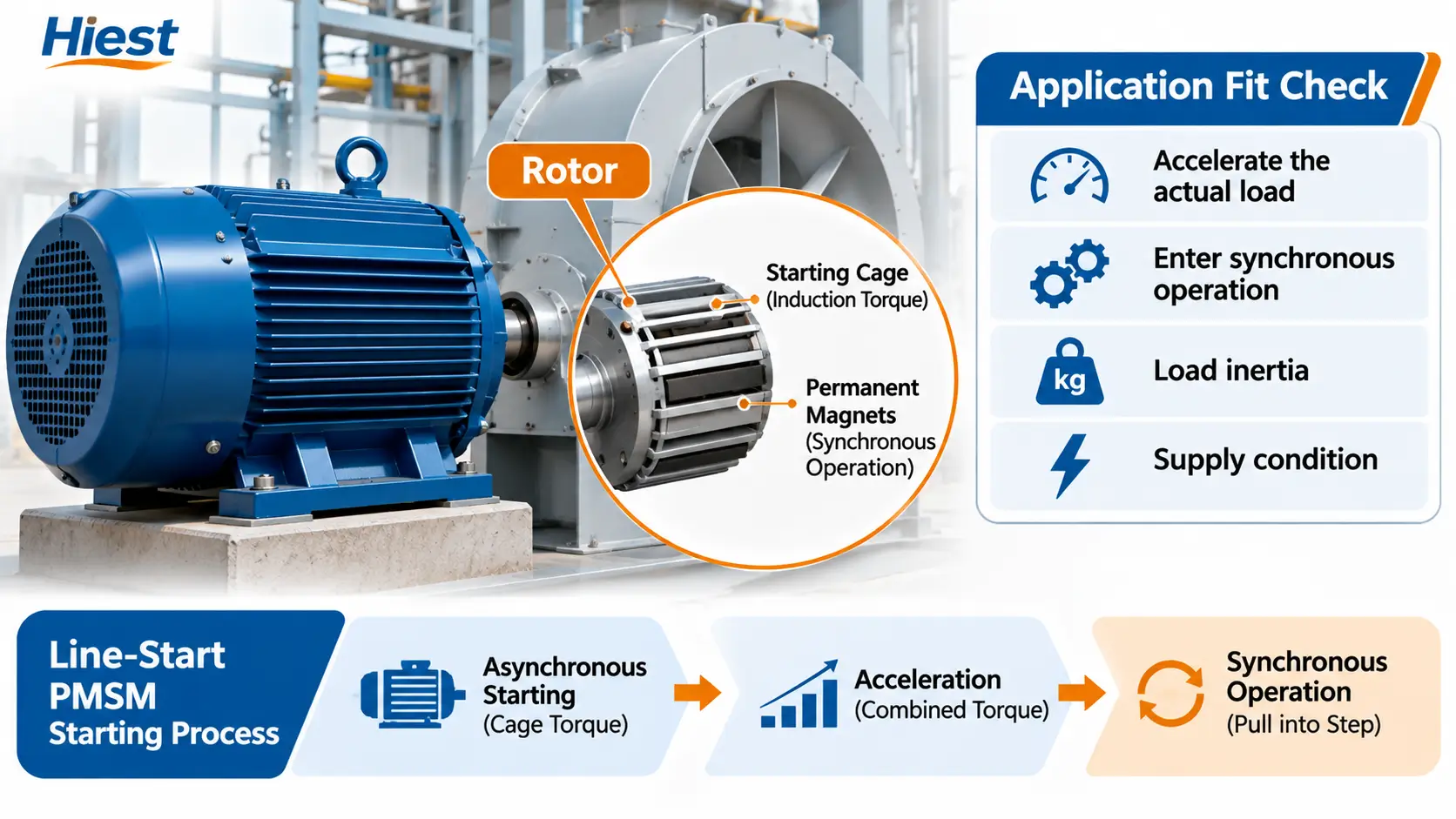
During asynchronous starting, the permanent magnets may also produce a braking torque component. The effective accelerating torque therefore depends on the combined electromagnetic behavior of the rotor rather than the cage torque alone.
This interaction is examined in the technical review Line-Start Permanent Magnet Synchronous Motors: Evolution, Challenges, and Industrial Prospects, which also discusses the relationship between load inertia, supply voltage, and synchronization capability.
Starting Torque and Load Inertia Conditions
A motor with sufficient rated running torque does not necessarily have sufficient starting capability for the connected machine.
During acceleration, the difference between developed motor torque and opposing load torque must provide the torque required to accelerate the total rotating inertia.
The available starting performance must be assessed over the relevant speed range, not only at standstill or rated speed.
Consider two machines with the same rated motor power.
One is a centrifugal fan operating continuously at fixed speed. The other is a loaded conveyor that must restart after an unexpected production stop.
The two applications can impose substantially different starting torque and inertia requirements. The fan may have a favorable load torque profile but substantial rotating inertia. The conveyor may require significant torque immediately upon starting.
Consequently, selecting the same rated line-start PMSM for both machines without reviewing their starting conditions would be unjustified.
The required assessment includes the load torque-speed curve, combined inertia referred to the motor shaft, actual starting load, expected acceleration time, and starting frequency.
Higher inertia or more demanding load torque can reduce the margin available for successful synchronization.
Pull-In Synchronization Is a Separate Acceptance Condition
Accelerating close to synchronous speed is not equivalent to completing a successful start.
The rotor must transition into stable synchronous operation. If the load and electromagnetic conditions do not permit this transition, the motor may fail to synchronize even after substantial acceleration.
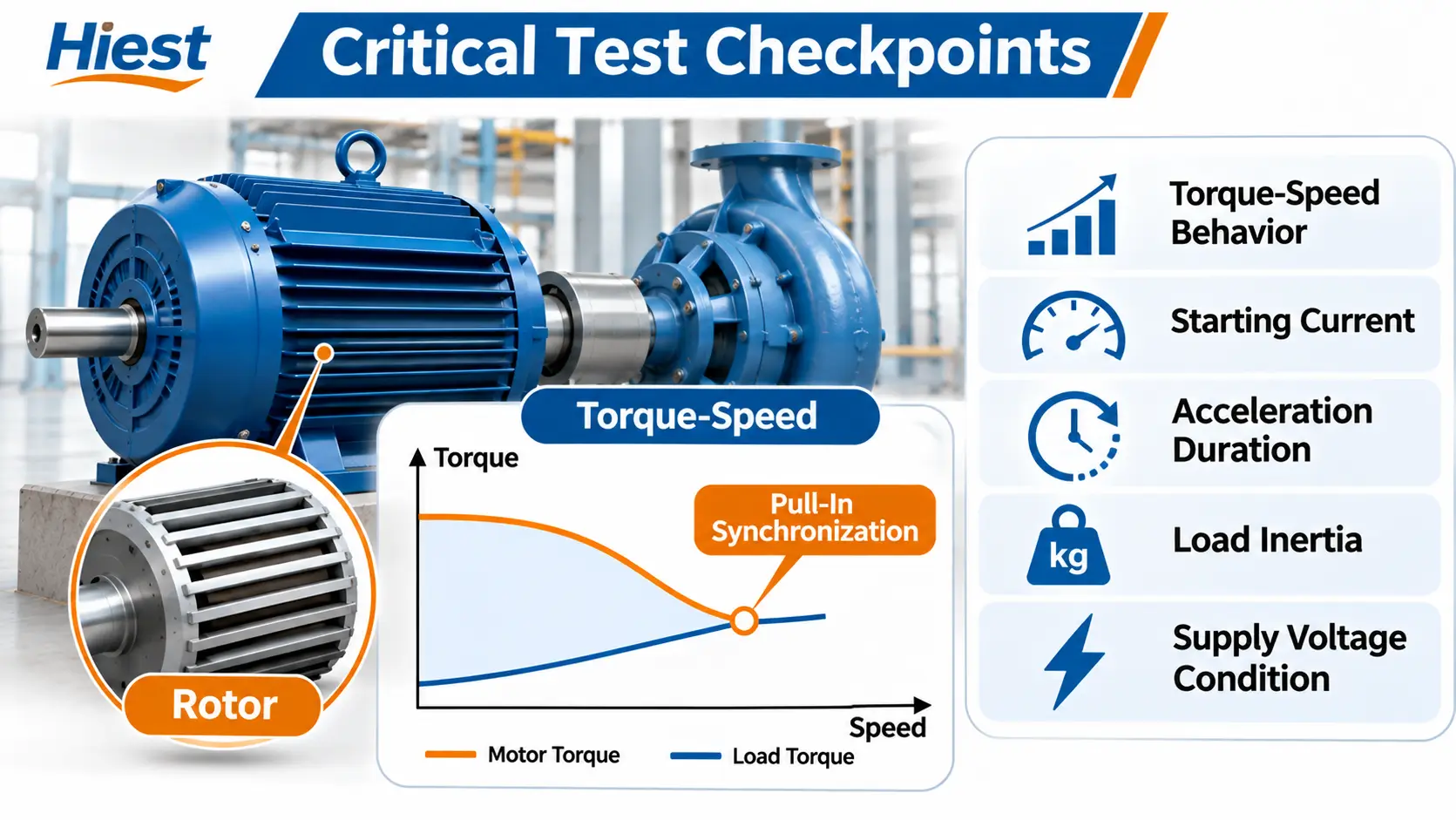
This distinction is particularly important for high-inertia equipment, loaded machinery, or installations experiencing reduced motor terminal voltage during startup.
A published study examining line-start PMSM operation with a centrifugal pump illustrates why voltage conditions and starting dynamics must be evaluated for the specific motor and installation.
The technical evidence should establish whether the proposed motor can complete the starting process under the actual duty.
A relevant manufacturer’s starting assessment may include torque-speed behavior, starting current, acceleration duration, the permissible load inertia, and synchronization capability under the specified supply conditions.
For difficult applications, simulation or model-specific testing may be needed rather than relying solely on nominal motor parameters.
Decision rule: A line-start PMSM remains a candidate only when both acceleration and pull-in synchronization can be supported by suitable technical evidence. If either condition is unverified, direct-on-line compatibility has not been established.
When an Inverter-Driven PMSM Provides a More Suitable Starting Solution
An inverter-driven PMSM becomes relevant when the starting process must be controlled rather than determined primarily by fixed-frequency direct supply and the motor’s inherent starting characteristics.
A compatible inverter controls the motor’s electrical excitation and acceleration. This enables the starting profile to be coordinated with the connected load, provided that sufficient current and torque are available.
For many industrial PMSM systems, field-oriented control is used to manage torque-producing current and rotor-field alignment.
The selected drive must support the actual motor type and its required control method. An inverter suitable for a conventional induction motor cannot automatically be assumed to support a PMSM.
Controlled Acceleration and Rotor Position Requirements
Drive-controlled acceleration allows speed commands and applicable current limits to be managed during startup.
This can be valuable in machinery where abrupt acceleration, high electrical starting demand, or uncontrolled mechanical transients are unacceptable.
However, current limitation does not remove the torque required to accelerate a high-inertia load.
If the selected acceleration time requires more torque than the combined motor and drive can deliver, the system may extend acceleration, encounter a current limit, or trip.
Rotor position information introduces another consideration.
Depending on the drive design and operating requirements, PMSM control may use an encoder, resolver, or sensorless position estimation.
Sensorless systems can require a specific low-speed starting strategy before reliable closed-loop position estimation is available.
For example, MathWorks documents sensorless field-oriented PMSM control using I-F startup, where the starting method transitions into closed-loop operation.
The existence of such control methods does not establish that every inverter offers the same low-speed torque, starting accuracy, or operating range.
For an industrial application, the proposed combination must be checked for starting torque, low-speed behavior, drive overload capability, motor parameter compatibility, and applicable feedback requirements.
Decision rule: Select the inverter-driven direction when controlled starting is required and a compatible drive can deliver the necessary torque across the actual acceleration profile. An inverter is not a remedy for an undersized motor or insufficient drive current capability.
Speed Control Capability: When Fixed Speed Is Enough and When an Inverter Is Necessary
The most direct reason to choose an inverter-driven PMSM is a requirement to change motor speed during operation.
A line-start PMSM operating in synchronism from fixed-frequency mains runs at the synchronous speed determined by supply frequency and motor pole count.
For ordinary direct-on-line operation, continuous electronic speed adjustment is not part of the configuration.
An inverter-driven PMSM can operate at different commanded speeds within its approved motor-drive envelope.
That envelope depends on continuous and peak torque, available voltage and current, cooling capacity, mechanical speed limits, and the control system.
The practical distinction can be made through three operating requirements.
Fixed-Speed Duty Without Process Regulation
If a machine runs continuously at one specified speed and process output is not controlled through changing motor RPM, adjustable speed may provide little operational value.
In this case, a line-start PMSM can be evaluated against the starting load, direct-supply requirements, and installation constraints.
There is no reason to add an inverter solely to obtain a function that the process does not use.
Variable-Speed Operation Under Changing Process Demand
Where a process changes its output through motor speed, electronic speed control becomes part of the required system architecture.
Examples include centrifugal fans with changing airflow demand, pumps with variable delivery requirements, and production machinery with adjustable throughput.
For these applications, the drive and motor must meet the required torque-speed characteristics throughout the operating range. A motor configuration designed for inverter operation should therefore be evaluated against the actual drive and load profile rather than treated as a standalone motor selection.
A PMSM’s ability to operate across a wide speed range under variable workloads should not be interpreted as a guarantee of constant torque, efficiency, or cooling performance at every operating point.
Fixed-Speed Operation With Controlled Starting
A machine may require only one steady operating speed but still benefit from an inverter.
For example, the equipment may have a high starting load, restricted supply capacity, or a requirement for a defined acceleration profile.
Here the inverter is justified by starting and integration requirements, not by normal operating speed variation.
A fixed-speed requirement therefore does not automatically establish that a line-start motor is suitable.
Decision rule: Separate steady-state speed requirements from startup and transient requirements. This prevents unnecessary drive selection while avoiding the assumption that fixed-speed equipment always permits direct-on-line starting.
Grid Direct Operation and Inverter Dependence: What Changes in the Installation?
The supply and control architecture can materially affect the feasibility of either PMSM configuration, particularly in retrofit projects.
A line-start PMSM designed for direct-on-line operation can be connected to a suitable fixed-frequency supply through the required switching and protection arrangement.
This may avoid the need to introduce a separate variable-frequency inverter.
However, compatibility with an existing electrical installation must still be established.
The motor must match the available voltage and frequency, and the starting process must be acceptable for the supply transformer, electrical distribution system, upstream protection, and connected loads.
An inverter-driven PMSM requires a compatible electronic drive and its associated control, protection, and installation arrangements.
This introduces requirements related to inverter sizing, motor electrical parameters, commissioning, wiring, electromagnetic compatibility, and integration with the existing automation system.
Some line-start motor designs can also operate with suitable inverter control. Therefore, the two categories should not be treated as an absolute rule that a line-start motor can never use a drive.
The meaningful comparison is between the proposed complete operating configurations.
Existing Motor Replacement
In an existing fixed-speed installation, a line-start PMSM may reduce the scope of electrical control modifications when direct supply is feasible.
But matching motor frame size and nominal power is not sufficient.
The replacement must also meet starting, speed, torque, mounting, shaft, cooling, and protection requirements, all of which matter when selecting a PMSM for a specific application.
A motor that fits mechanically but cannot synchronize the connected load is not a successful replacement.
If the facility already uses a PMSM-compatible inverter and machine control system, an inverter-driven configuration may be more consistent with the existing equipment.
The actual drive must nevertheless be checked for compatibility with the replacement motor.
New Equipment Development
For new machinery, inverter dependence can be evaluated as part of the intended control architecture.
If variable-speed operation and electronic control are fundamental requirements, the inverter is a necessary system component rather than an optional accessory.
If the machine has a stable fixed-speed duty, the potential value of a simpler line-connected configuration can be examined alongside the load and supply constraints.
Decision rule: Compare the proposed motor together with the electrical supply, controls, protection, commissioning, and required modifications. Do not evaluate inverter dependence as a motor-only cost difference.
Starting Current, Electrical Constraints and System-Level Cost
The difference between direct starting and inverter-controlled starting can influence the electrical infrastructure required for a project.
During a direct-on-line start, the line-start PMSM draws its starting current from the supply. The magnitude and duration depend on the specific motor design and connected loading.
The resulting voltage disturbance must remain acceptable to other equipment connected to the electrical system.
Where supply capacity is limited, protection coordination is restrictive, or nearby process equipment is sensitive to voltage disturbances, starting-current behavior can become a decisive selection constraint.
An inverter-driven PMSM can manage the motor’s acceleration and output current within the drive’s limits.
This may reduce starting transients compared with direct-on-line operation, but it does not mean that the inverter’s input current, harmonics, or power-quality effects can be ignored.
Compare the Complete System Cost
Eliminating a separate inverter can reduce certain equipment and integration costs, but a line-start system should not be assumed less expensive in every installation.
The relevant cost comparison includes the motor, required power electronics, electrical distribution changes, protection, commissioning, operating energy, maintenance, and expected service life.
For an existing installation, the cost of downtime or mechanical modifications may also affect the decision.
Energy cost must be evaluated against actual operating conditions.
A fixed-speed motor operating near a consistent load should not be compared with a variable-speed system using an unrelated duty cycle or different process output.
For centrifugal fan and pump applications with variable demand, speed control can provide energy benefits by reducing the work required from the driven equipment.
The U.S. Department of Energy’s industrial fan system guidance identifies variable-speed control as an energy improvement option for suitable fan systems.
However, those potential savings are associated with the process and operating profile. They are not proof that any particular inverter-driven PMSM will deliver a specified percentage of savings compared with a line-start PMSM.
Likewise, the absence of a separate inverter does not establish the total energy cost of a line-start configuration.
Decision rule: Where both systems satisfy the technical requirements, compare their installed cost and expected energy consumption under the same delivered duty. Do not use generic efficiency labels or unverified payback figures to determine the preferred architecture.
Application Fit: Where Each PMSM Configuration Makes Engineering Sense
The most useful application comparison begins with operating conditions rather than industry names.
A pump, fan, conveyor, or compressor does not automatically belong to one motor category. Different machines within the same industry can require different starting and control characteristics.
Fixed-Speed Fans and Centrifugal Pumps
A fixed-speed fan or centrifugal pump may be a suitable candidate for a line-start PMSM when the starting torque profile, connected inertia, and electrical supply permit reliable synchronization.
This is particularly relevant when the machine operates for long periods at a stable duty point and the project does not require electronic speed regulation.
Nevertheless, a large fan can have substantial inertia. A fixed-speed requirement alone is not evidence that direct-on-line starting will succeed.
For a variable-flow process, an inverter-driven PMSM may offer a better overall system configuration because the motor speed can follow actual demand.
The distinction is the operating duty and starting requirement, not whether the equipment is called a fan or pump.
Conveyors and Material Handling Equipment
Conveyors can impose significant starting torque, particularly when restarting under load.
The relevant conditions include initial load torque, total inertia, required acceleration time, stopping frequency, and the relationship with other equipment.
A line-start PMSM may be considered where fixed-speed duty and motor starting characteristics are compatible with the loaded machine.
An inverter-driven PMSM is generally more appropriate when the production process requires controlled acceleration, adjustable throughput, or coordination with other driven equipment.
For loaded conveyors, sufficient starting and overload torque must be confirmed regardless of the control architecture.
Compressors and Processing Machinery
Compressor starting characteristics vary substantially by machine design and control arrangement.
An unloaded-start configuration may produce very different demands from a machine required to restart under pressure.
The decision should therefore reflect the actual compressor type, unloading method, torque-speed curve, and operating cycle.
Line-start operation can be considered when the fixed-speed starting conditions are compatible with the motor.
Inverter-driven operation becomes relevant where capacity is adjusted through speed, acceleration must be controlled, or the machine must operate across multiple defined operating points.
Similar reasoning applies to mixers, extruders, and other processing equipment with demanding torque characteristics.
High-Inertia and Frequent-Start Applications
High inertia and frequent starting are important conditions because they can expose the limitations of a direct-start configuration.
For line-start PMSM applications, the synchronization and thermal requirements must be reviewed together.
For inverter-driven applications, the drive’s overload capability, motor thermal limits, acceleration profile, and braking requirements must be evaluated.
Neither configuration should be approved solely because a comparable rated-power motor has been used in another machine.
Application Decision Matrix
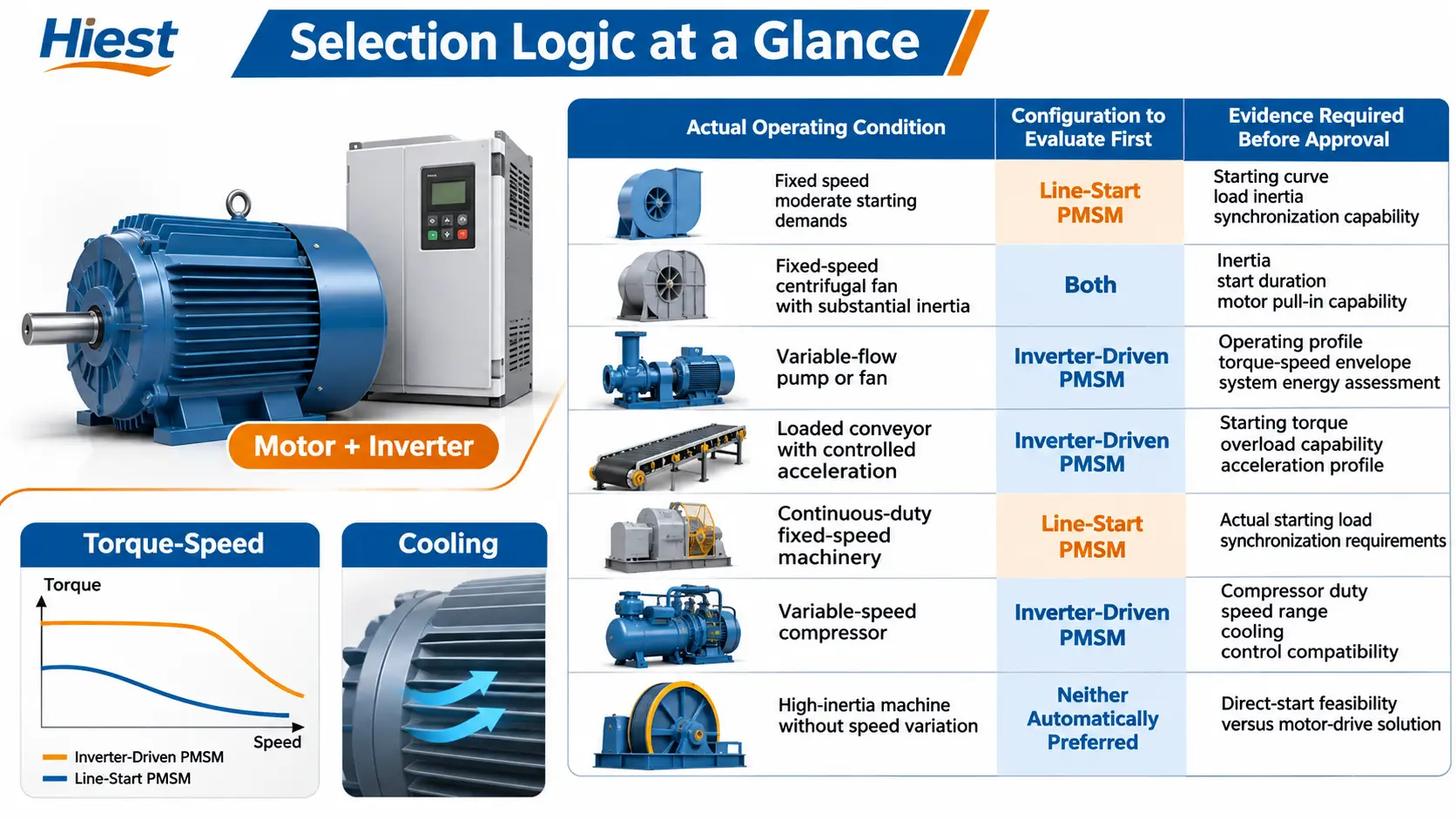
| Actual operating condition | Configuration to evaluate first | Evidence required before approval |
|---|---|---|
| Fixed speed, moderate starting demands, adequate mains supply | Line-start PMSM | Starting curve, load inertia, synchronization capability |
| Fixed-speed centrifugal fan with substantial inertia | Both, pending technical review | Inertia, start duration, motor pull-in capability, supply impact |
| Variable-flow pump or fan | Inverter-driven PMSM | Operating profile, torque-speed envelope, system energy assessment |
| Loaded conveyor with controlled acceleration | Inverter-driven PMSM | Starting torque, overload capability, acceleration profile |
| Continuous-duty fixed-speed machinery | Line-start PMSM may be considered | Actual starting load and synchronization requirements |
| Variable-speed compressor | Inverter-driven PMSM | Compressor duty, speed range, cooling, control compatibility |
| High-inertia machine without speed variation | Neither automatically preferred | Direct-start feasibility versus motor-drive sizing |
| Equipment with repeated starts and stops | Inverter-driven PMSM may offer greater flexibility | Thermal duty, acceleration, stopping and protection requirements |
| Existing fixed-speed motor replacement | Line-start PMSM may reduce system changes | Electrical, mechanical, starting and protection compatibility |
| Existing electronic PMSM drive system | Inverter-driven PMSM | Drive support, motor parameters and control integration |
This matrix is an initial engineering selection tool, not a substitute for model-specific validation.
The operating condition determines which configuration deserves priority. The technical evidence determines whether that configuration can actually be approved.
Project Decision Rules: What Must Be Confirmed Before RFQ?
A motor selection becomes commercially useful when the proposed configuration can be supported by specific operating requirements and verifiable technical data.
For an equipment manufacturer, the objective is to avoid specifying a motor configuration that satisfies nominal power and speed requirements but fails during startup, commissioning, or actual production duty.
The following decision sequence provides a practical basis for technical review.
Decision 1. Does the Equipment Require Adjustable Speed?
If variable-speed operation is a functional requirement, prioritize an inverter-driven PMSM configuration.
The required operating speed range, continuous torque, peak torque, cooling conditions, and motor-drive compatibility must then be defined.
If the machine operates at one speed, retain line-start operation as a candidate and proceed to the next decision.
Decision 2. Can the Motor Accelerate and Synchronize the Actual Load?
For a line-start candidate, starting compatibility must be demonstrated using the relevant motor and load characteristics.
Rated power alone cannot establish this.
The assessment should account for the load torque-speed relationship, combined inertia, motor starting performance, synchronization conditions, and permissible starting duty.
If successful synchronization cannot be supported, the proposed direct-on-line configuration should not be approved without further engineering review.
Decision 3. Can the Electrical Installation Support the Starting Method?
The supply must be evaluated for voltage, frequency, available capacity, starting current, voltage disturbance, and protection coordination.
If direct starting is not acceptable, a compatible controlled-start configuration or another appropriately engineered alternative should be evaluated.
Decision 4. Does the Proposed Control Architecture Meet the Machine Requirements?
For inverter-driven PMSM applications, the selected drive must support the motor’s electrical characteristics and required control functions.
This includes starting strategy, speed range, torque capability, feedback requirements, overload limits, and integration interfaces.
A drive already installed in the facility should not be considered compatible solely because its power rating appears adequate.
Decision 5. Which Configuration Offers the Better System-Level Fit?
Once both configurations have passed the relevant technical checks, compare the actual project consequences.
These include installed equipment, commissioning scope, electrical changes, expected operating energy, maintenance requirements, control integration, and lifecycle cost.
A lower initial motor price does not necessarily result in a lower installed cost. Similarly, greater control capability does not automatically create commercial value when the process does not require it.
Information Required for Manufacturer Technical Evaluation
| Required project information | What it establishes | Required manufacturer assessment |
|---|---|---|
| Equipment type and application | Actual machine duty | Appropriate motor configuration |
| Existing motor specification, if applicable | Replacement baseline | Electrical and mechanical compatibility |
| Rated and operating torque-speed requirements | Load envelope | Continuous and peak torque suitability |
| Total inertia referred to motor shaft | Acceleration demand | Starting and synchronization feasibility |
| Starting load and required acceleration time | Transient operating condition | Starting performance or drive sizing |
| Start frequency and operating cycle | Thermal duty | Permissible starting and operating limits |
| Supply voltage, frequency, and electrical constraints | Power system conditions | Direct-start or inverter supply suitability |
| Required speed range and control precision | Normal operating requirements | Control method and speed envelope |
| Existing inverter and protection configuration | Integration constraints | Compatibility and protection coordination |
| Cooling, installation, and environmental conditions | Operating limitations | Thermal and mechanical suitability |
For line-start PMSM proposals, the key confirmation is whether the motor can accelerate and synchronize the connected machine under the specified conditions.
For inverter-driven PMSM proposals, the key confirmation is whether the complete motor-drive combination can deliver the required operating and transient performance.
Verification Before Final Motor Approval
A technically supported proposal should identify the relevant motor model or proposed design, the evaluated operating conditions, and the basis for its performance conclusions.
Depending on the project, the supporting documentation may include a motor performance datasheet, applicable torque-speed curves, starting calculations or simulations, a drive compatibility assessment, dimensional drawings, and results from permanent magnet motor testing.
Any unresolved assumption should remain visible in the technical review rather than being converted into an unconditional performance claim.
Hiest’s motor development scope includes self-starting PMSMs, variable-frequency PMSMs, and application-specific permanent magnet solutions. The actual motor configuration, available series, and application suitability should be confirmed against the project requirements.
Conclusion
Line-start and inverter-driven PMSMs should be selected according to the actual motor-drive system requirements rather than a general preference for direct starting or electronic control.
Line-start PMSMs are candidates for suitable fixed-speed, grid-fed duties when starting and synchronization can be verified. Inverter-driven PMSMs are generally better suited to applications requiring variable speed, controlled acceleration, or electronic control integration.
Where both configurations remain feasible, the final decision should consider supply compatibility, load behavior, installation requirements, and total operating cost.
For industrial motor projects, the most useful next step is not another generic comparison of motor technologies. It is a model-specific review of the load, starting conditions, electrical system, and required operating envelope.