
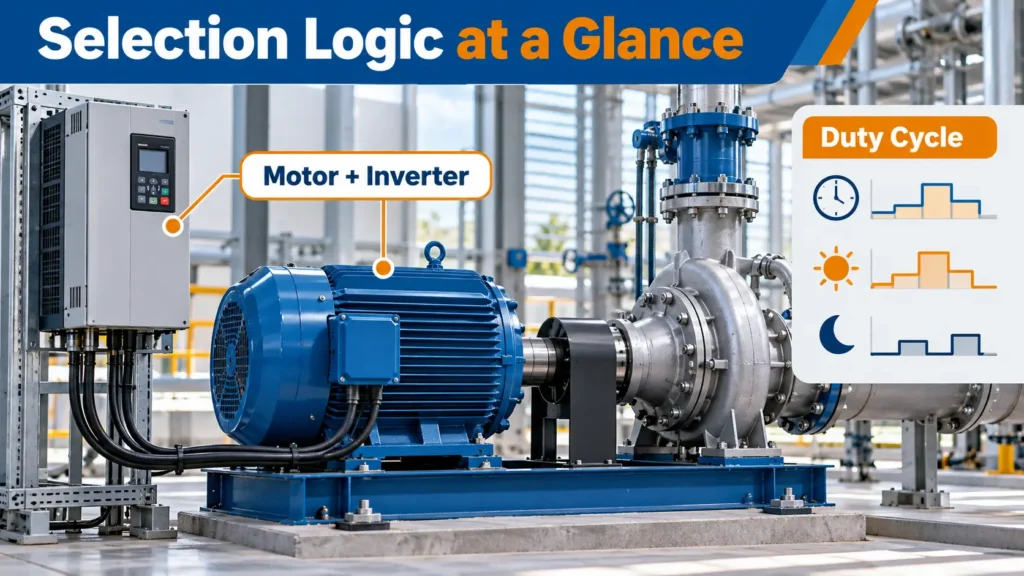
For an engineering manager in Singapore, the question is not simply whether a permanent magnet synchronous motor (PMSM) has a higher efficiency rating. It is whether a particular motor-and-drive configuration can deliver measurable benefits for a real machine, at an acceptable total project cost. This matters for long-running pumps and fans, process equipment and selected industrial automation systems—yet the answer can be different for each duty cycle.
Singapore’s Green Plan 2030 and its emphasis on efficient buildings and industrial operations make energy performance a relevant business priority. Neither national policy nor a motor’s nameplate efficiency, however, proves that a specific retrofit will save money. Engineers must establish torque and speed requirements, operating hours, drive compatibility, site conditions, installation work and actual electricity costs.
Consider a PMSM when comparable motor-drive data and the project’s operating profile indicate a meaningful system-level benefit. Use the application matrix, four-step selection process, compliance checks and transparent payback model below to decide whether to proceed to technical validation, request additional data or retain the existing motor.
When Does a PMSM Make Sense for a Singapore Industrial Project?
PMSM suitability depends on the operating requirements and the existing drive system. A higher nameplate efficiency value alone does not establish a favourable project case.
Project Conditions That May Favour PMSM Adoption
Three conditions justify closer evaluation. First, long annual operating hours increase the weight of any efficiency difference. Second, variable-speed duty allows the motor-drive system to operate across a wider load range, where PMSM loss behaviour can differ from an induction motor. Third, applications where power density or a smaller frame reduces integration cost can create value beyond energy consumption. Each condition must be tied to a measurable engineering requirement.
When an Induction Motor May Remain the Better Choice
A functioning induction motor may remain economical when annual operating hours are low, when the existing motor is already well matched to a stable load, or when integration work would require extensive panel, cabling or mechanical modification. The practical decision rule is to compare feasible motor-drive systems over the same duty cycle rather than committing to replacement on the basis of a nominal efficiency class alone. IEC 60034-30-2 provides a framework for classifying variable-speed machines, but it does not by itself prove a project-level saving.
PMSM Applications Across Singapore’s Key Industrial Sectors
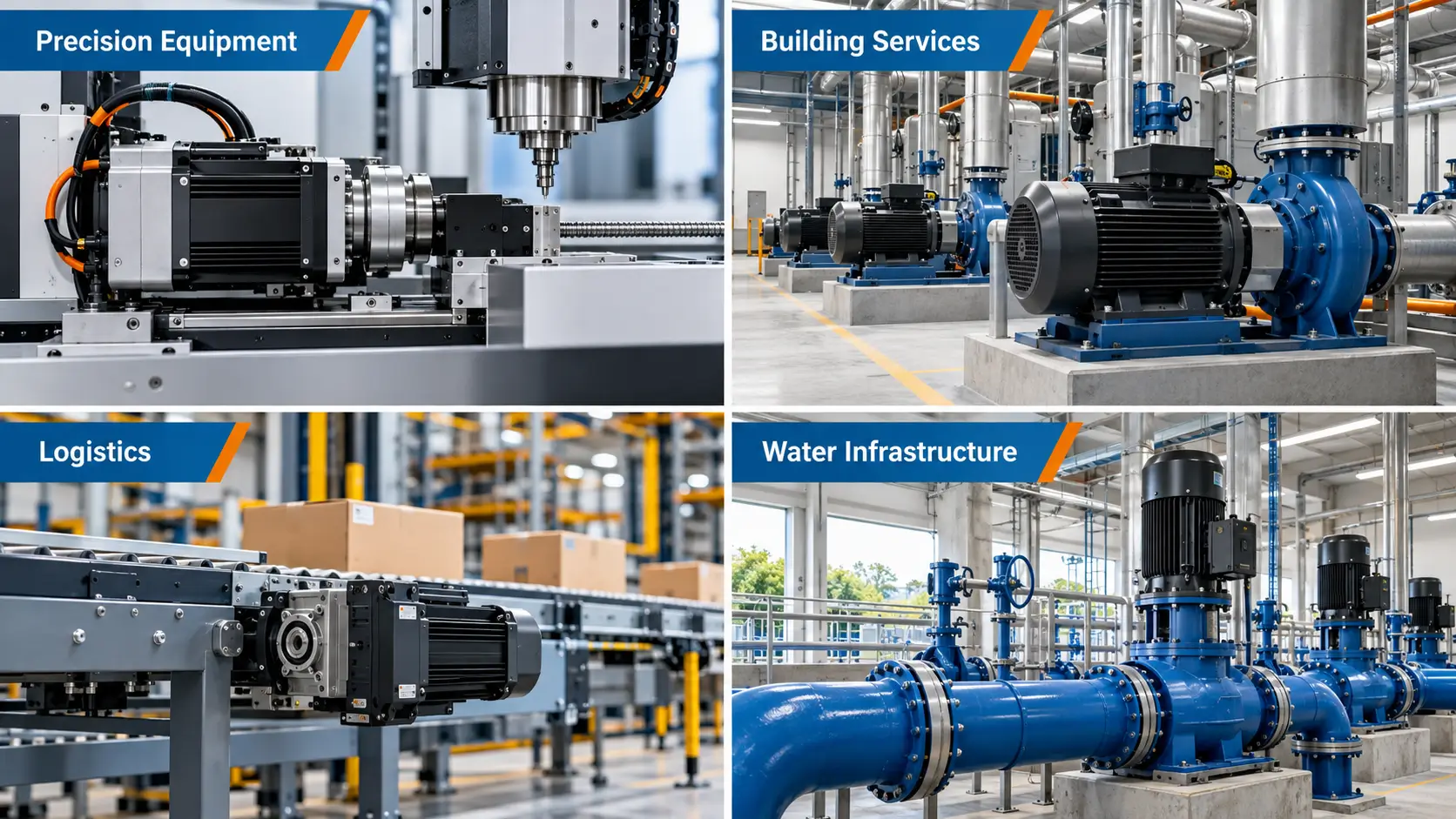
Application suitability differs between precision equipment, building services, logistics and water infrastructure. The matrix below identifies the engineering variables that require evaluation in each sector. The sectors are presented as local industry contexts, not as verified deployments of any specific motor model.
Precision Manufacturing and Semiconductor Facilities
Singapore’s advanced manufacturing base includes semiconductor production and precision engineering, where equipment reliability and controlled production environments are critical. See the Singapore EDB advanced manufacturing overview.
Cleanroom air-handling equipment and precision motion stages should be treated as separate evaluation problems. For air systems, continuous operation, load profile and reliability dominate. For precision motion, torque ripple, positioning accuracy, vibration and drive feedback must be validated against the complete motion-system requirement.
A general-purpose industrial PMSM cannot automatically be treated as a qualified precision servo motor.
Commercial and Industrial HVAC Systems
Cooling-tower fans, pumps and ventilation fans are potential evaluation scenarios because their load often varies with weather, occupancy and process demand.
The relevant variables are the fan or pump load curve, the operating schedule, and the efficiency of the motor-drive system at the actual speed and torque points.
A motor replacement is not the same project as a complete system retrofit, and BCA Green Mark evaluates building-level energy performance rather than certifying an individual motor model.
Port Logistics and Industrial Automation
Singapore’s Tuas Port is developing automated container-handling operations using electrified yard cranes and automated guided vehicles, according to the Maritime and Port Authority of Singapore.
These are local application contexts, not Hiest installation references. For logistics applications, low-speed torque, frequent acceleration, regenerative operation and control compatibility require evaluation.
AGV traction is a vehicle-specific design problem, and an industrial PMSM intended for fixed equipment should not be treated as an approved AGV motor without a separate vehicle-level validation.
Water and Wastewater Treatment Systems
Pumping and process-drive applications in water infrastructure place a premium on matching the motor to the pump curve across the required flow and pressure range.
Long operating hours make part-load efficiency relevant, but the measured pump-system efficiency is more informative than a motor-only efficiency claim. Electrical and mechanical interface requirements, including variable-speed operation and installation conditions, must be confirmed before a motor is selected.
The table below summarises the application evaluation logic.
| Application area | Primary engineering variables | Suitable evaluation criteria | Limitation |
|---|---|---|---|
| Precision manufacturing and semiconductor | Duty cycle, torque ripple, positioning accuracy, vibration, drive feedback | Complete motion-system performance against process tolerance | General-purpose industrial PMSM is not a qualified precision servo |
| Commercial and industrial HVAC | Fan or pump load curve, operating schedule, speed-torque profile | Motor-drive system efficiency at actual operating points | A motor purchase does not establish BCA Green Mark compliance |
| Port logistics and automation | Low-speed torque, acceleration frequency, regenerative duty, control compatibility | Vehicle or equipment-level duty-cycle validation | Industrial PMSM is not an approved AGV traction motor without vehicle validation |
| Water and wastewater | Pump curve, flow and pressure range, annual hours | Measured pump-system efficiency across demand range | Motor substitution alone does not determine system savings |
PMSM vs Induction Motors: Performance and Project Trade-Offs
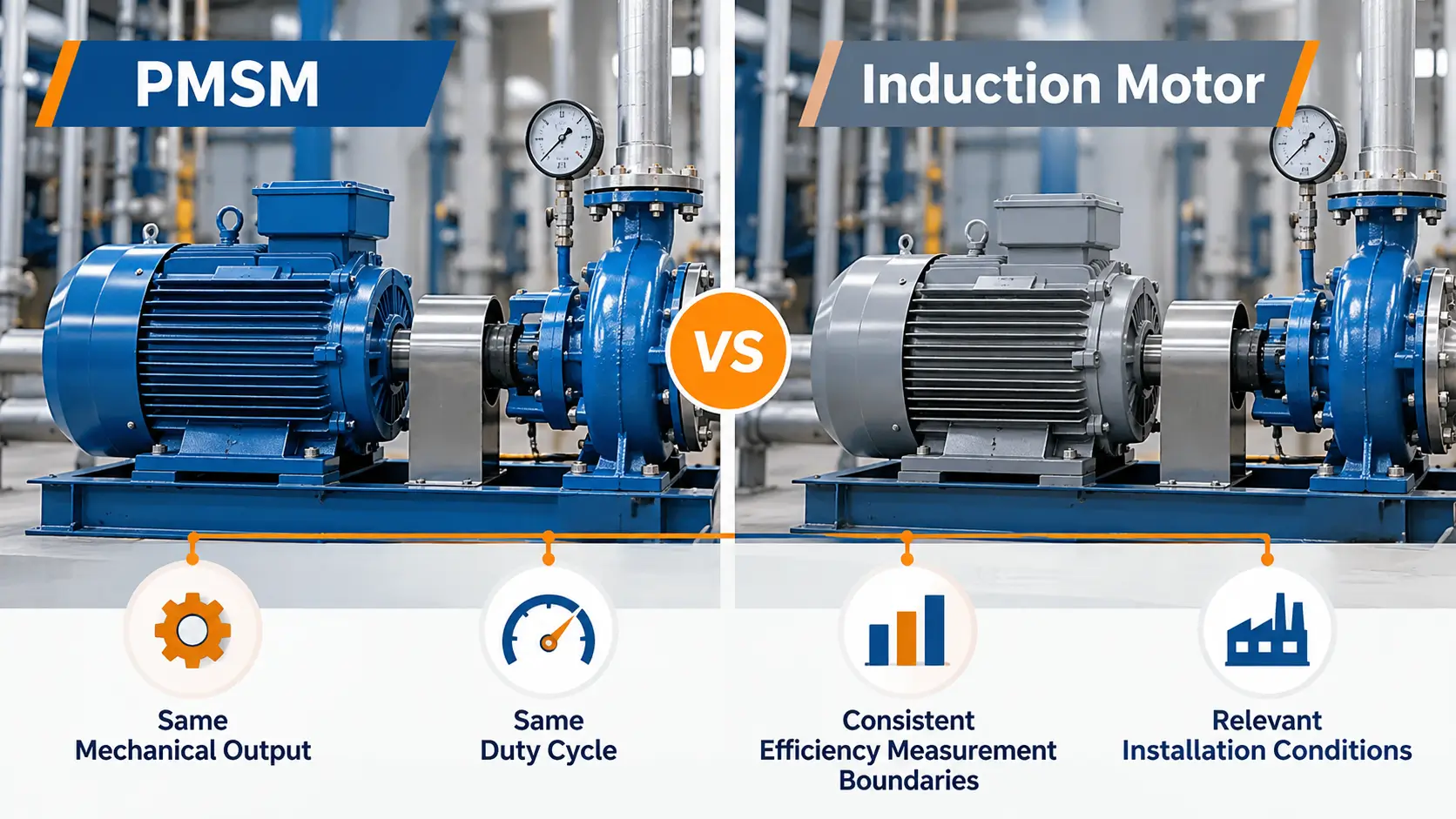
A fair comparison requires similar mechanical output, the same duty cycle, consistent efficiency measurement boundaries, and relevant installation conditions. Comparisons that use different load points or different system boundaries cannot support a project decision.
Efficiency, Speed Control and Power Density
A PMSM rotor rotates synchronously with the stator field under normal operation, so it does not experience the slip that occurs in an induction motor. The loss mechanisms differ, and the practical consequence is that rated efficiency and part-load efficiency should be evaluated separately.
IEC TS 60034-30-2 provides efficiency classes for variable-speed machines, while IEC 60034-2-3:2024 specifies test methods for converter-fed motors and procedures to determine losses at defined load points. These standards support a structured comparison, but they do not convert a nominal class into a guaranteed site saving.
The difference between rated motor efficiency and total system electricity consumption is important.
For example, a fan or pump may spend much of its life below rated load. A nameplate comparison cannot capture the drive’s electrical losses, changing load, flow-control method or maintenance costs. IEC 60034-2-3:2024 describes defined testing of converter-fed motors at operating points; it is not a site-specific savings guarantee.
Initial Investment, Integration and Lifecycle Trade-Offs
The initial investment difference is not confined to the motor. A conventional inverter-fed PMSM requires a compatible drive with appropriate control, motor identification and protective functions. Installation may require panel modification, different cabling or revised mechanical interfaces.
These integration costs can outweigh the motor price difference on a small or poorly matched project.
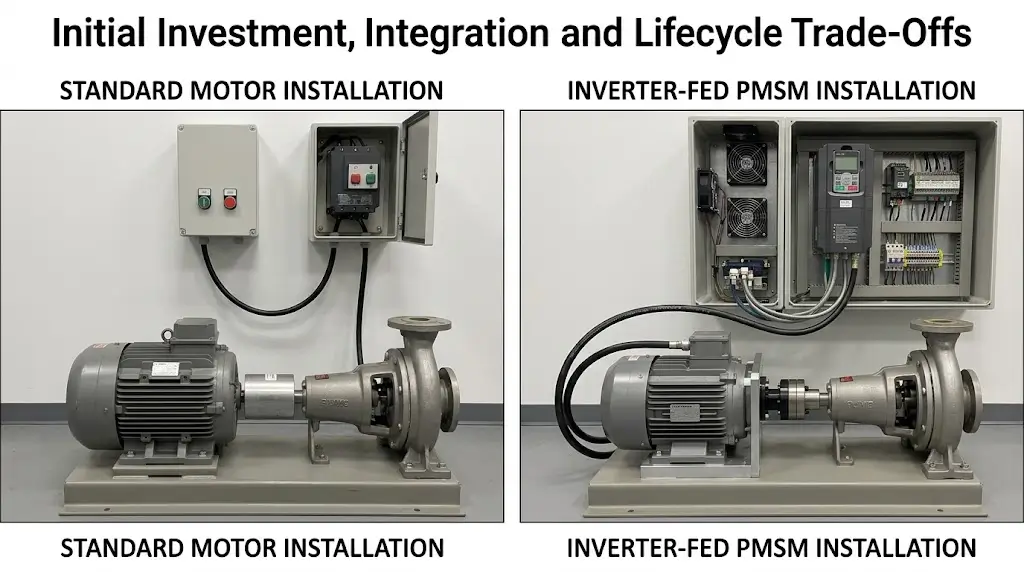
The lifecycle comparison depends on annual working hours, the electricity tariff applicable to the site, maintenance requirements and expected service life.
The conditional rule is that a PMSM is worth pursuing when the incremental investment can be recovered within the organisation’s accepted payback threshold under a realistic duty cycle, and when the drive and mechanical integration are technically feasible.
The table below sets out the comparison dimensions without assigning universal values.
| Comparison dimension | What to establish | Why it affects the decision |
|---|---|---|
| Rated efficiency | Motor efficiency at the defined rated point under an applicable test standard | Establishes a baseline but does not represent part-load operation |
| Part-load and variable-speed performance | Loss behaviour at the actual speed-torque points in the duty cycle | Determines whether the efficiency advantage is realised in service |
| Drive compatibility | Inverter control method, motor identification, feedback and protection | An incompatible drive can negate motor benefits or create reliability risk |
| Physical integration | Frame size, shaft, mounting, cooling and clearance | May require mechanical modification and downtime |
| Lifecycle economics | Incremental capital cost, annual energy difference, maintenance and service life | Determines whether the technical benefit is commercially justified |
Step-by-Step PMSM Project Selection Guide for Singapore Engineers
The selection process should progress from mechanical load data to environmental limits, drive integration and installation feasibility. A motor recommendation requested before these steps are complete cannot be evaluated properly.
Step 1: Define Load Profile, Torque and Duty Cycle
The first step is to establish the equipment being driven, the actual running speed or speed range, the mechanical output required, the peak torque, the starting frequency and the annual operating hours.
Rated torque and maximum torque are different quantities, and continuous duty and intermittent duty produce different thermal requirements.
The relationship between power, speed and torque should be used to check whether a proposed motor covers the required torque-speed envelope.
The minimum data set before requesting a recommendation includes the driven equipment type, required output power or torque at each operating point, speed range, duty cycle, annual hours, starting and stopping frequency, and any load inertia or acceleration requirement.
Step 2: Evaluate Tropical Conditions and Thermal Requirements
Singapore’s ambient temperature and humidity are relevant, but not every installation is exposed to the same conditions. An air-conditioned plant room, a naturally ventilated industrial hall and an outdoor equipment enclosure present different thermal and condensation risks.
The evaluation should use the actual site ambient temperature, humidity exposure, ventilation and the possibility of condensation during shutdown.
The motor datasheet should be read for the permitted ambient temperature, the ingress protection rating and the insulation class. For example, Hiest’s published water-cooled PMSM table lists IP54 and Class F insulation for specific models, while its rare-earth PMSM page lists an ambient-temperature range of -15°C to 40°C for that series.
These are model- or series-specific catalog claims, not a blanket tropical-climate approval. IP rating and insulation class address different aspects of protection and are not interchangeable, and neither one alone proves suitability for a particular tropical installation.
Step 3: Match the PMSM with a Compatible Inverter
A conventional inverter-fed PMSM requires a drive that can operate at the required frequency, voltage and current, and that provides the appropriate control mode, motor identification and protective functions. The torque-speed coordination between motor and drive must be confirmed across the full operating range.
Line-start PMSM designs, which can operate directly on the supply in some configurations, follow different selection rules and should not be treated as equivalent to inverter-fed PMSMs.
Before accepting a proposed motor-inverter combination, the project should confirm the inverter’s rated output current at the required carrier frequency, the supported control method, the motor parameter identification procedure, the feedback requirement, the overload capability and the thermal protection settings.
Step 4: Confirm Retrofit and Installation Feasibility
Retrofit feasibility depends on mounting arrangement, shaft dimensions, coupling type, mechanical clearance and the interface with the existing equipment. Commissioning time, production downtime, drive-panel modification, cable routing and acceptance testing are project costs or constraints, not afterthoughts.
The decision to proceed to engineering approval should be made only when the mechanical interface, electrical integration and commissioning plan are defined well enough to price the total project.
Which PMSM Configuration Fits Your Industrial Requirements?
The motor configuration must follow the application constraints, not a predetermined preference for a product category. Hiest offers several PMSM configurations for technical evaluation, but the suitability of any configuration depends on model-level confirmation against the project data.
Standard Three-Phase PMSM
For many fixed industrial drives, begin by evaluating a Hiest three-phase PMSM against the application’s continuous torque, rated and maximum speed, mounting interfaces and compatible drive. Do not assume that every unit has the same pole count, frequency or control requirements.
The published series and model datasheet—not the generic term “PMSM”—must determine the candidate specification.
Explosion-Proof PMSM
Explosion-proof PMSM configurations become relevant when the motor is installed in a classified hazardous location. The actual Ex marking, gas or dust group, temperature class and certificate scope must match the location classification and the applicable installation requirements.
The existence of an explosion-proof PMSM product category does not mean that every model is approved for every hazardous area, and the certificate must be checked for the specific model and marking.
Water-Cooled PMSM
Water-cooled PMSM configurations can be considered when the heat-rejection duty, available cooling loop or space constraints make liquid cooling attractive.
A water-cooled motor introduces additional project requirements, including cooling-water availability, temperature, flow, quality and the consequences of a cooling interruption. These conditions must be validated at the system level.
Rare-Earth PMSM
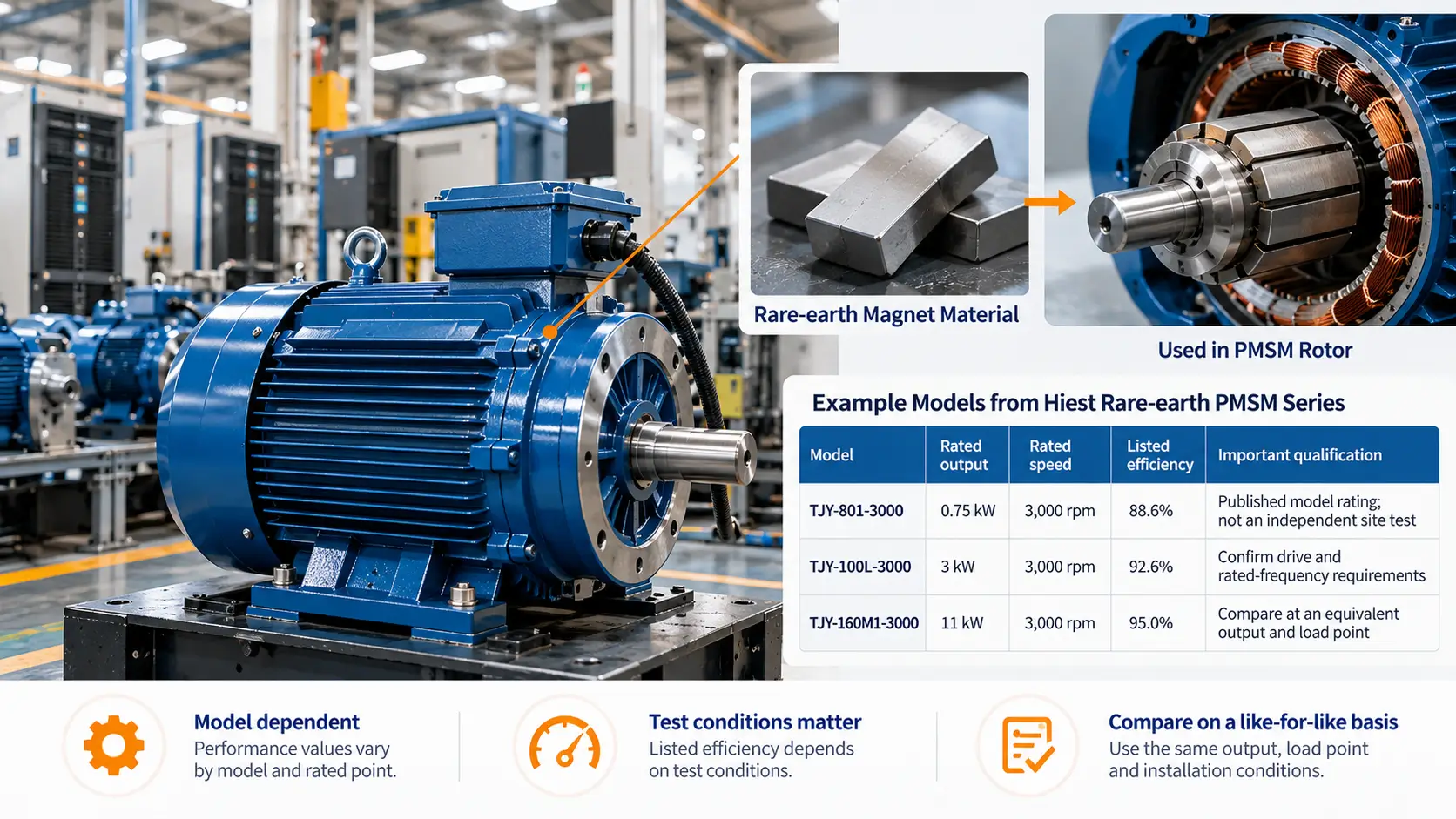
Rare-earth PMSMs use a magnet material choice within the broader PMSM family; this is not a separate, mutually exclusive motor operating principle. Published performance values vary by model, rated point and test conditions. The Hiest rare-earth PMSM product table provides a useful example:
| Published Hiest model | Rated output | Rated speed | Listed efficiency | Important qualification |
|---|---|---|---|---|
| TJY-801-3000 | 0.75 kW | 3,000 rpm | 88.6% | Published model rating; not an independent site test |
| TJY-100L-3000 | 3 kW | 3,000 rpm | 92.6% | Confirm drive and rated-frequency requirements |
| TJY-160M1-3000 | 11 kW | 3,000 rpm | 95.0% | Compare at an equivalent output and load point |
These are manufacturer-published specification figures, not independently verified operating savings. The same table lists different rated frequencies for different models.
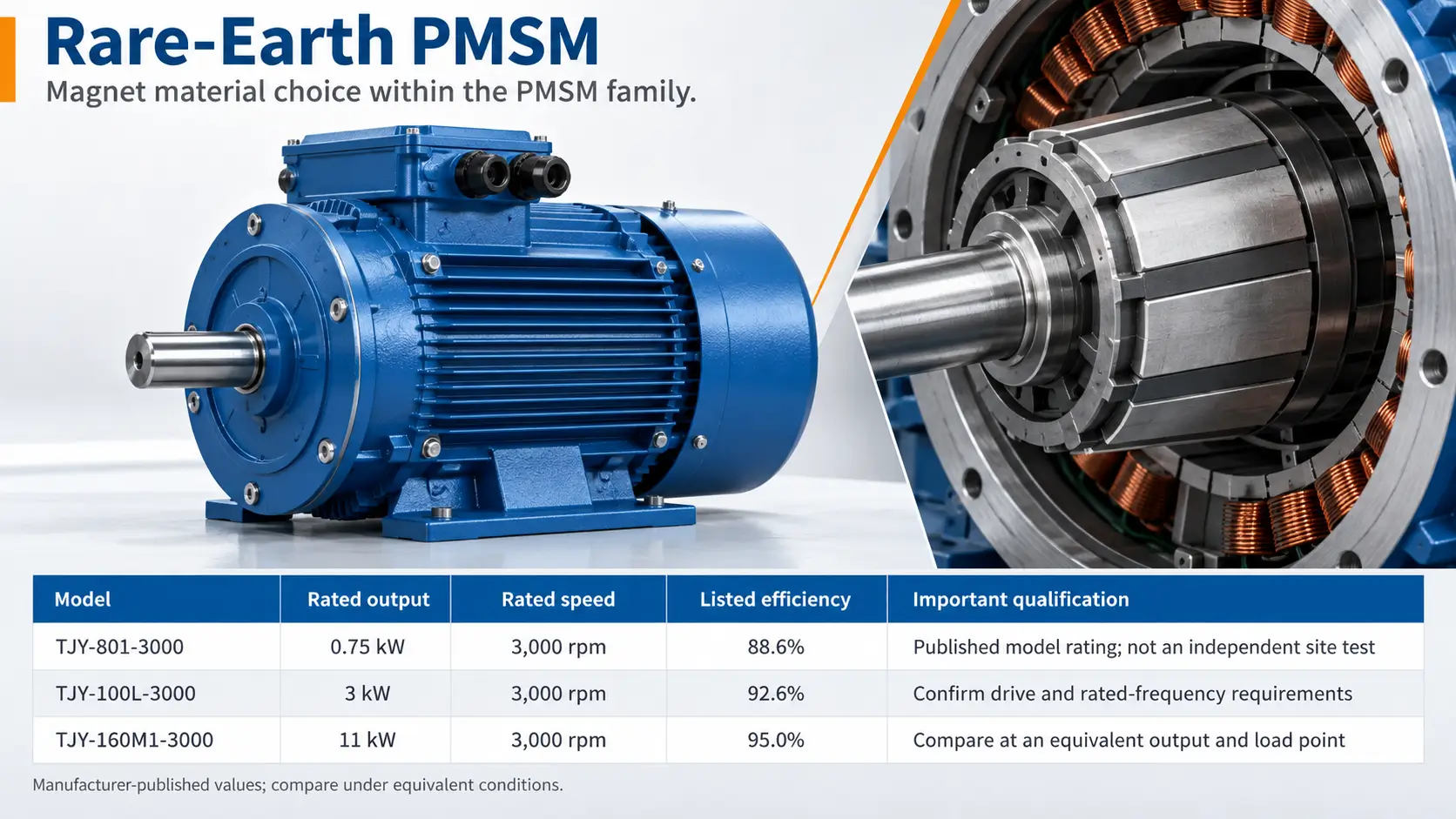
Engineers should therefore confirm the requested speed, supplied voltage, inverter output-frequency range and measurement basis before using the listed efficiency in a project estimate.
Singapore Electrical Requirements and Project Risk Checks
Standards and regulatory requirements apply according to the installation type, equipment category, electrical connection and project scope. A blanket compliance claim is not a substitute for confirming the applicable requirements for the specific project.
Power Quality, Harmonics and Electrical Installation
Inverter-fed motor systems can draw non-sinusoidal current from the supply. A project-level power-quality review should distinguish the drive’s current harmonics from voltage distortion at the facility’s point of common coupling.
The applicable limits and measurement method depend on how the installation connects to the network, the equipment and its operating conditions.
Do not apply an arbitrary total harmonic distortion (THD) percentage to all Singapore low-voltage drives: values in a transmission-system code may refer to kilovolt-level networks rather than 230 V or 400 V installations.
Singapore’s Electricity (Electrical Installations) Regulations refer to SS 638, Code of Practice for Electrical Installations. SS 638 addresses electrical installation requirements; it should not be described as a blanket harmonics limit for every inverter.
The project’s licensed electrical worker or qualified electrical engineer should identify any applicable EMA, network-operator and connection-specific requirements, then assess input reactors, appropriate drive designs or filtering if the results justify them.
Green Mark, Motor Efficiency and Regulatory Scope
BCA Green Mark 2021 assesses building-level sustainability and energy performance. It does not certify an individual PMSM merely because that motor has a high efficiency value. For an HVAC project, evaluate how the motor and drive affect fan, pump or cooling-system performance and how those results fit the building’s assessment requirements.
The National Environment Agency’s published industrial motor MEPS covers specified three-phase induction motors; its regulated scope must not be applied automatically to PMSMs. For inverter-fed permanent-magnet machines, IEC TS 60034-30-2 provides a relevant efficiency-class framework, while IEC 60034-2-3:2024 provides methods for determining converter-fed motor losses and efficiencies. Project teams should request model-specific ratings, the measurement basis and the relevant documents before making compliance statements.
Environmental, Safety and Acceptance Risks
The main environmental risks in a tropical installation are overheating from inadequate ventilation, condensation during shutdown or temperature cycling, and cooling-system failure where liquid cooling is used. Installation constraints such as restricted space, high ambient temperature near other equipment or contaminated air can also affect the selected motor’s permitted operating conditions.
Where a hazardous area applies, the actual product certification and marking must be verified against the area classification. The acceptance record before commissioning should include the motor and drive nameplate data, the relevant test or conformity documents, the installation inspection record, the protection settings and the functional test results for the complete motor-drive system.
PMSM Retrofit Costs, ROI and Singapore Energy Efficiency Grants
Project economics must be calculated from measurable system performance and the actual commercial conditions of the project. A payback period taken from a general industry claim is not a project calculation.
How to Calculate PMSM Energy Savings and Total Cost of Ownership
The total cost of ownership should include the motor purchase price, the compatible drive, installation and commissioning, the electrical energy consumed over the operating profile, and the maintenance and service-life costs. The energy comparison should use electrical input power at equivalent mechanical output points across the duty cycle, with a clearly stated system boundary.
A transparent calculation compares annual electrical input energy for the existing motor-drive system and the proposed system:
Annual energy difference (kWh) = Σ (P input, existing − P input, proposed) × annual hours at each operating point
Annual net saving (SGD) = annual energy difference × applicable electricity tariff − incremental annual maintenance cost
Simple payback (years) = incremental project investment ÷ annual net saving
Simple payback is useful as a screening indicator, but it does not capture the time value of money, the service life of the equipment or the effect of tariff changes. A lifecycle financial evaluation should be used where the project scale or capital approval process requires it.
Illustrative ROI Scenario for a High-Utilisation Industrial Drive
Consider a hypothetical pump or fan duty running 6,000 hours per year. Assume that, at the same mechanical output and representative duty point, the existing motor-drive arrangement takes 30.0 kW from the supply and the proposed PMSM-based arrangement takes 28.5 kW.
Use an illustrative, not quoted, electricity price of SGD 0.27/kWh and an incremental installed project cost of SGD 12,000. No grant is assumed. This example is a calculation exercise, not a Hiest performance test or an actual Singapore customer project.
The matrix is a screening tool rather than a substitute for detailed design. A technically compatible candidate should still undergo performance validation, protection review and site acceptance before procurement release.
Conversely, keeping a sound induction motor may be a valid engineering decision when the estimated benefit is marginal or the retrofit risk is disproportionate.
Information Required Before Approving the Motor Configuration
The minimum inputs are the driven equipment and application, required mechanical output and torque-speed range, supply voltage and frequency, inverter details if one is proposed, mounting and shaft dimensions, ambient and cooling conditions, annual operating schedule, and any certification or documentation requirement.
These inputs are sufficient to progress to model evaluation and quotation. Additional documents that do not affect the motor selection should not delay the technical review.
Quick Answers to Common PMSM Selection Questions
Does every PMSM need a VFD? No. Line-start PMSM designs can operate directly on the supply in certain configurations, while conventional inverter-fed PMSMs require a compatible drive. The project should confirm the motor topology and the intended starting and control method.
Is a PMSM always more efficient than an induction motor? No. Efficiency depends on the specific models, the operating points and the system boundary.
A PMSM may show a larger advantage at some load points and a smaller advantage at others, and the comparison must use equivalent mechanical output and a defined test method.
Does a higher motor efficiency guarantee a short ROI? No. The payback depends on annual hours, the actual efficiency difference at the operating points, the electricity tariff, the incremental installed cost and the service life. A higher-efficiency motor can have a long payback if the operating hours are low or the integration cost is high.
Next Steps: Evaluate a PMSM Project with Hiest
A model-specific technical discussion is appropriate when the application, load profile and installation conditions are sufficiently defined to evaluate a candidate configuration. At that stage, the project can move from general suitability to a quotation and technical review.
Prepare the Technical Data for a PMSM Enquiry
Provide the application and driven equipment, required mechanical output and torque-speed range, supply details, inverter information if available, mounting and shaft dimensions, ambient and cooling conditions, annual operating schedule, and any required certification or documentation. These inputs allow the proposed configuration to be checked against the actual project conditions rather than against a generic application description.
Review Hiest Motor Configurations and Request a Quote
Hiest publishes product references for standard three-phase PMSMs, explosion-proof PMSMs, water-cooled PMSMs and rare-earth PMSMs. Review the published specifications for the series that matches the application, then submit the project data for technical review and a project-specific quotation.
The review should focus on operating points, drive compatibility, environmental limits, model-specific approvals and the documents required for this particular project.

Engineering References and Singapore Sources
- IEC 60034-2-3:2024 — Converter-Fed Motor Efficiency Testing
- EMA — Singapore Electrical Standards and Technical References
- Enterprise Singapore — Energy Efficiency Grant (EEG)
- EDB — Incentive Programmes, including REG(E)
Editorial verification: October 23, 2026. Figures in the payback illustration are explicitly hypothetical. Product catalog data are manufacturer-published and must be verified for a selected model before purchase or installation.